admin
adminPrinciple AI tools : https://use.ai/
Principle Ai tolls ; https://app.alle-ai.com/
Video generator tools – https://www.aixploria.com/en/category/video-generators/
Gemini OMNI – https://gemini.google/overview/video-generation/


- Artificial intelligence (AI)
- Personal productivity
- Mem
- OpenAI
- ChatGPT
- Jasper
- Fireflies.ai
- Motion
- Asana
- Anthropic (Claude)
- Notion
- Writer
- Buffer
- Avoma
- Microsoft Outlook
- Gmail
- Zapier Agents
- Zapier
- Canva
- Gamma
- Granola
- Hive
- ClickUp
- Evernote
- Perplexity
- Runway
- Buffer
- ElevenLabs
- FeedHive
- Hume
- Reclaim
The best AI productivity tools by category
-
AI orchestration and automation (Zapier)
-
AI agent builders (Zapier Agents, Botpress)
-
Search engines (Perplexity, Komo, Brave)
-
Grammar checkers and rewording tools (Grammarly, Wordtune, ProWritingAid)
-
Video creation and editing (Runway, Descript, Google Veo 3)
-
Image generation (ChatGPT, Midjourney, Ideogram)
-
Voice and music generation (ElevenLabs, Hume, Speechify)
-
Knowledge management and AI grounding (Mem, Notion, Evernote)
-
Transcription and meeting assistants (Fireflies, Avoma, Granola)
-
Email (Shortwave, Microsoft Copilot Pro for Outlook, Gemini for Gmail)
-
Slide decks and presentations (Gamma, Canva, Beautiful.ai)
-
Resume builders (Teal, Enhancv, Kickresume)
How I selected the best AI productivity app in each category
It seems like every time I turn around, there are a dozen more AI tools clamoring for attention. And the tools I’ve used for years—like Notion, Canva, Grammarly, and (against my will) Microsoft—have added AI features and assistants to their platforms.
To be fully transparent, I haven’t gotten around to testing every single AI tool on the market, mostly because it would be easier to count the glitter particles left over after a kindergarten art project. But I’m doing my best to make a dent in the ever-growing list.
The list you’re about to see contains a collection of great AI productivity tools tested by Zapier’s app review team, myself included. If there’s a particular category you like, check out the best apps lists we’ve put together for them.
While all these apps are getting better every day, they’re far from perfect: be sure to always check AI’s work with your human brain. With that being said, please keep all hands and legs inside the vehicle—it’s time to explore.
1. Apps for AI orchestration and automation
AI tools are great at individual tasks, but the real magic happens when you can connect them together. If your stack already looks like a toolbox with a dozen half-used gadgets, you’re in good company—more than 4 in 10 enterprises run multiple AI vendors at once to spread their risk.
The upside is flexibility; the downside is that nobody’s tools are talking to each other. Nearly 80% of enterprises are struggling to integrate AI with their current tech stacks, which is why your first stop should be choosing an AI orchestration layer that can coordinate how all your apps, data, and AI tools interact so your work actually flows.
Zapier

Zapier is built to help your tools and AI work together seamlessly across 9,000+ apps. It’s a hub that lets you do everything from analyzing business data with AI to creating entire automated systems that react instantly (and intelligently) to real-time triggers.
Zapier’s AI productivity features include:
-
Copilot: your natural language builder for automation. Describe what you want to happen (“summarize new leads in Slack every morning”), and Copilot will draft a complete workflow, then connect your accounts, map the data, and even test each step automatically.
-
AI by Zapier: built-in access to ChatGPT with no API key required. You can extract data, generate text, summarize content, or analyze information, all within your automated workflows.
-
Zapier Agents: intelligent, self-directed AI teammates that can take multi-step actions across your tech stack. Agents can handle anything from drafting emails to preparing reports, and they work across apps autonomously. You can even use the Chrome extension to trigger them from anywhere on the web.
-
Chatbots by Zapier: custom, no-code bots trained on your own content—like a help center or website—that can answer questions, guide customers, or handle internal requests. You can set them to automatically check for new updates so they always stay current.
-
Tables: a flexible, spreadsheet-style database that lets you store, organize, and update the data your automations and AI agents rely on. Use it to track projects, leads, business data—anything that needs structure—and connect it directly to your Zaps or AI workflows.
Put it all together, and Zapier acts as your AI productivity control center. Connect AI models, trigger them with real-world data, and orchestrate how they interact with every other app your team uses.
2. AI chatbots
AI chatbots allow you to chat with a large language model, letting you ask questions and get answers in a conversational style. The best chatbots use advanced reasoning and logic, write code, and make mathematical calculations.
Take a look at the full list of chatbots in our article on the best AI chatbots.
ChatGPT

ChatGPT is the current industry leader, and the first chatbot that set the scene on fire—and it’s surprisingly flexible and very easy to use. Learn how to use ChatGPT, understand how it works, and discover how to use it to write marketing copy, do market research, or write sales emails.
You can also use Zapier’s ChatGPT integration to connect it with thousands of other apps, allowing you to orchestrate workflows that bring AI into every stage of your operations. For example, after an event ends, you can automatically collect attendee feedback from survey tools, have ChatGPT summarize the responses into key themes, and generate personalized follow-up emails based on participant engagement. Learn more about how to automate ChatGPT.
Claude

Anthropic’s safe and creative chatbot, Claude builds Artifacts: it can code simple interactive interfaces, write documents in a separate tab, or even design games for you. Make changes with prompts on the left side of the screen and see them come into shape on the right.
Zapier also integrates with Claude, enabling you to orchestrate sophisticated workflows that combine its reasoning capabilities across your tech stack. For example, you can use AI to analyze contracts or research reports, enrich the output with contextual data, and then distribute those findings across Slack, email, or your internal knowledge base—all without manual intervention. Discover more ways to automate Claude.
Meta AI

Meta AI is available across Meta’s social apps globally, and even as a standalone assistant powered by Meta’s latest LLM. You can talk to it in conversations, tag it in chats, generate or edit images, and feed it context from Facebook, Instagram, WhatsApp, and Messenger for richer responses.
Meta AI is clearly part of Meta’s vision to weave AI through its social ecosystem. If you’re active on any of Meta’s apps, it’s worth trying—just keep in mind that enabling Meta’s AI features does come with some privacy red flags. You have to sign in with an Instagram or Facebook account to access Meta AI, which means the assistant will pull context from your social data—including private messages—to both tailor responses and train its models.
3. AI apps for building agents
While chatbots let you talk to AI, agent builders let you put AI to work. These tools go beyond conversation into taking action, connecting to your apps, and automating complex workflows across your tech stack.
AI agents are teammates that can do everything from managing your inbox to orchestrating entire business processes. Take a look at the full list of tools in our article on the best AI agent builder software.
Zapier Agents

Thanks to Zapier’s integrations with 9,000+ apps, Zapier Agents can take action across all your work tools. And the interface is a chatbot, which means that creating your own AI agent is as simple as using ChatGPT.
Start by giving your agent access to your company’s source of truth in apps like HubSpot, Notion, and Airtable. You can ask it about your data as well as all the data in your apps—and data sources will sync automatically.
And you can train your agents to work even while you’re not there: tell your agent what to do when it’s triggered, how to process or summarize data, and which actions it should take, all without writing a line of code. These agents are like mini-teammates who help you with specific tasks, like analyzing your spreadsheets, searching the web, or drafting responses to customers.
It’s AI chat, automation, and data analysis all in one place. Learn more about Zapier Agents, and then get started for free.
Botpress

Botpress isn’t hard to use, exactly, but it’s definitely built with developers in mind. You’ll likely spend more time reading the documentation here than with most AI tools, but that’s kind of the point: Botpress is made for building serious bots.
The app combines prompts, knowledge bases, tools, and communication channels so you can design custom agents that actually do what you need, whether that’s handling customer chats, running internal workflows, or living on your website as a helpful AI concierge. It also has a great visual builder, as well as plenty of options for data management and integrations.
4. AI search engines
Hallucinations are one of the biggest issues with AI. To counter this risk, some tools build web searches into their apps, using the results as sources to support the AI-generated answer. And that’s an AI search engine in a nutshell.
Get the full tour in our article on the best AI search engines.
Perplexity

Leading the pack, Perplexity is attracting a lot of attention due to its high-quality answers, great quoting of sources, and staying on topic even as you ask follow-up questions. It uses a combination of Google’s, Bing’s, and proprietary ranking signals to decide which results are best to base the AI response on. It’s really good to use alongside a classic Google search if you’re digging into tricky topics—I’m still amazed by the niche things I found while researching with Perplexity. Curious? Read Zapier’s Perplexity full guide here.
Because Perplexity integrates with Zapier, you can connect it with thousands of other apps, embedding an AI orchestration layer into every step of your daily workflows. For example, you can automatically capture new industry news from Perplexity, have AI generate an executive summary with key takeaways and suggested actions, and share it with your leadership team in Slack. Learn more about how to automate Perplexity.
Komo
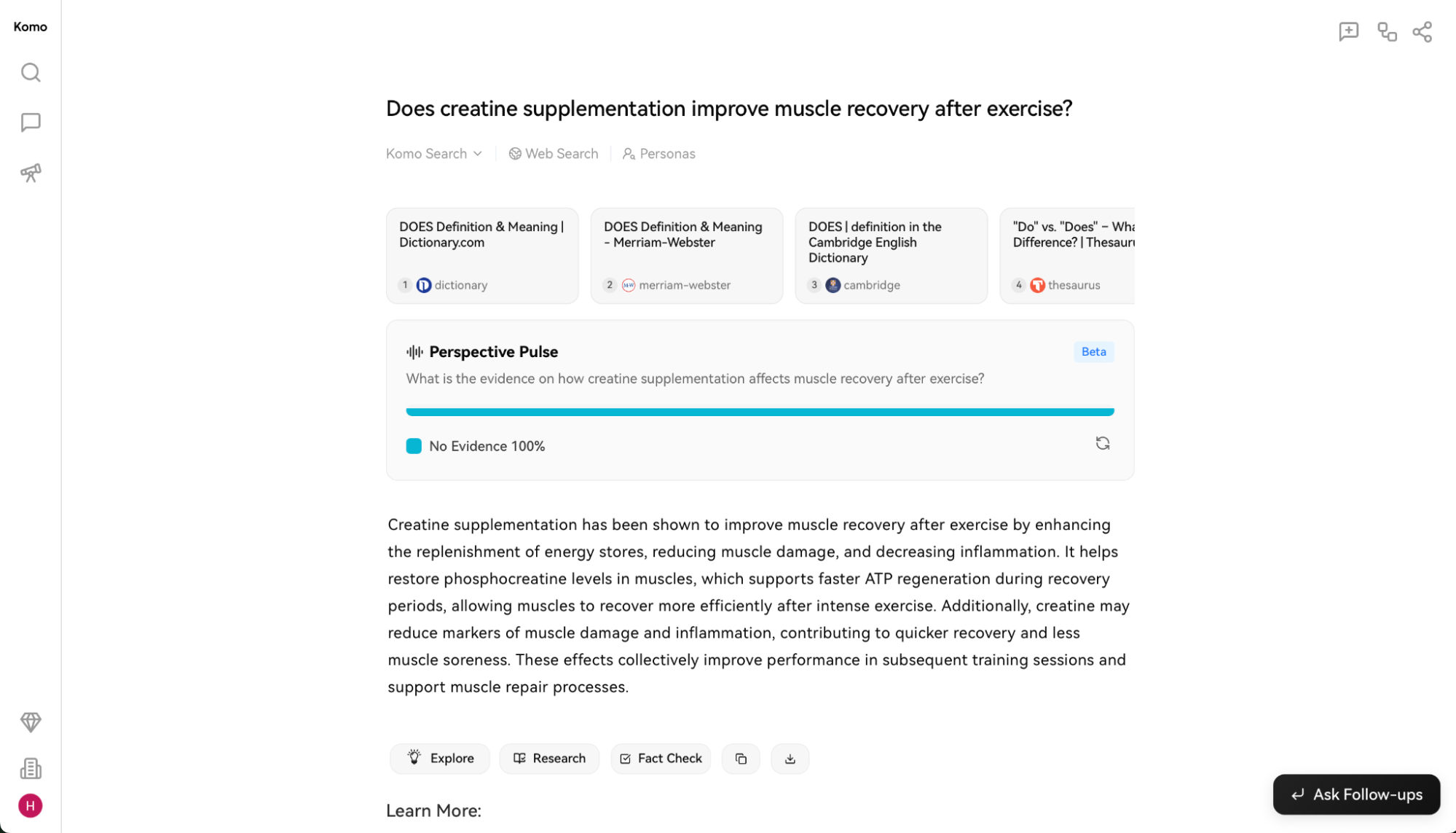
Komo gives you a surprising amount of control for something that feels so simple. You can pick your AI model, choose a search persona like “explainer” or “equity researcher,” and decide whether you want a standard AI search, deep research mode, or just plain old traditional search. You can even set where it looks—across the web, academic papers, or your own uploaded data.
While it’s not perfect (the Perspective Pulse feature, which promises a quick summary of the general consensus on a topic, is often off-base), there’s a lot to like here. Komo feels ambitious, fast, and headed in the right direction.
Brave

Brave has always been known as the privacy-first browser that blocks ads, trackers, and general internet nonsense. Now, while Google and Bing are busy fumbling their way through AI answers, Brave quietly went and built an AI-powered search engine that actually works. The generated summaries show up at the top of your results, and the answers tend to be more accurate than Google’s. They’re consistently cited properly, and you can even usually ask follow-up questions without the AI getting weird about it.
Privacy, of course, is Brave’s whole thing. It doesn’t track your searches, build a creepy profile of your activity, or target you with hyper-personalized ads. The only ads you’ll see are based on the words you searched—not on the 3 a.m. shopping spiral you went on last week.
5. AI apps for content creation
Entire movies have been made about writer’s block. These apps are here to break it. By entering your prompts, starting from templates, or using recipes, you can use AI models as a co-writer, helping you put together first drafts faster.
Browse all the possibilities in our list of the best AI writing generators.
Jasper

Jasper is a powerful AI content creation platform, favoring users who need a high volume of content. Unlike an AI chatbot like ChatGPT, it packs dozens of templates to help you get started, connects to the internet to find research and sources, and also lets you generate images with AI. All your content creation needs are covered here.
You can also connect Jasper to thousands of other apps using Zapier. This way, you can layer AI within multi-step workflows across tools and teams. For example, you can automatically create tailored ad copy based on campaign briefs, send drafts for approval in Slack or your project management apps, and upload final assets into your CMS or DAM system. Here are more ways to automate Jasper.
Anyword

Anyword helps marketers create content by breaking the generation process down step by step. First, you add your prompt to generate a few titles. Then, you can pick your favorite and see a generated outline. Once you tweak that outline to what you want to cover, you can move forward to generating the final piece.
Writer

Big businesses can’t afford missteps. A misplaced fact or an inaccurate claim can hurt brands, tank reputations, and take things to court. Where other LLMs tread gray areas, Writer offers their proprietary LLMs and plenty of tools to make sure your content stays true. On top of it, Writer will help keep brand voice consistent for teams who collaborate on publishing. That’s the productivity boost of AI with fewer risks.
By connecting Writer with Zapier, you can embed brand-safe AI writing into your company’s workflows at scale. For example, when your marketing team drafts a campaign brief, you can have AI generate channel-specific copy, applying your company’s brand guidelines and style rules automatically. It can also route the content to legal for approval, translate it for regional markets, and then push the final assets into your publishing and project management tools. Here are more ways to automate Writer.
6. AI apps for text enhancement
Spell-checking has been around for a long time, but AI is changing the game. Before, it only detected spelling and basic structure errors. Now, it can spot tone and complex language and offer suggestions to make your writing clearer.
Discover all the available apps in our list of the best grammar checkers.
Grammarly

Grammarly is the mainstream spell- and structure-checking app. It’s a complete solution that keeps your English on point, lets you adjust your tone, and suggests shortcuts to simplify wordy or complex phrases. It has plenty of extensions and integrations, so you can use it almost anywhere there’s a text box. It has basic generative text features, too.
Wordtune

Wordtune helps you find plenty of wording alternatives to improve your text. When you input the text you want to check, you can easily browse synonyms, ask to rewrite entire sentences, and adapt the suggestions into a final draft.
ProWritingAid

ProWritingAid is a direct competitor of Grammarly, offering plenty of statistics to help you track grammar, style, and spelling scores. One of the main advantages here is its lifetime plan, helping you leverage all these features without adding a new recurring bill. Find out which is the best for you in our ProWritingAid vs. Grammarly comparison.
7. AI apps for video generation and editing
While full-blown video generation is still coming together, there’s already a set of video tools that leverage AI to enhance video, remove backgrounds accurately, and even paint a few new images into each frame.
For the full list, see our picks for the best AI video generators.
Runway

Runway is a video magic wand. It has a set of interesting features that help you generate video with AI, train your own models, and paint parts of frames using text prompts. The new Gen-4 model can combine visual references with instructions to generate new images and videos in consistent styles and locations. It’s a big step up in AI video generation, making it one of the best commercially available solutions. The learning curve is very rewarding, and the app is growing at a great pace.
If that’s not enough, Runway also connects with Zapier. This means you can connect it with thousands of other apps and orchestrate AI-powered workflows across your organization. For example, when someone shares a video idea in Slack, you can use ChatGPT to automatically refine it into a polished prompt and send it to Runway to create. Once Runway’s created the video, it can notify your team in Slack for review.
Descript

Descript transcribes your videos into a script. Then, instead of using a timeline to trim the audio and video tracks, you edit the text script. As you do so, the video gets trimmed automatically. The rest of the editing works in a similar way, cutting the time to edit your talking head videos. Find out how it simplifies your audiovisual workflows in our walkthrough.
Google Veo 3

Google Veo 3 can take a simple prompt—like “make a cinematic shot of a golden retriever running through a field at sunset”—and turn it into a high-quality, fully rendered video, complete with camera movement, lighting, and emotion. It still has the usual AI quirks: faces sometimes slip into the uncanny valley, objects morph mid-frame, and the camera occasionally moves like it’s had too much coffee. But for the most part, it’s stunning. The realism is good enough that most viewers can’t tell what’s AI and what’s actual footage.
Veo 3’s visuals are crisp and cinematic, and it can even compose soundtracks and generate dialogue (from a script you give it) with surprisingly accurate lip sync. The built-in filmmaking app also gives you granular control over building scenes and remixing videos.
8. AI apps for image generation
An image is worth a thousand words, but you don’t need so many to generate a beautiful one with AI. These image generators take a text prompt and deliver the results—and this can be anywhere between mind-blowing and nightmare-inducing. They’re both hugely entertaining and highly useful.
Read more about our picks for the best AI image generators.
ChatGPT

ChatGPT can natively generate images, and it’s one of the best image generators you can use right now. It’s also one of the simplest. No settings, sliders, or extra prompts to fine-tune the vibe (unless you want to). It relies on autoregression—a fancy way of saying it’s thinking things through as it draws—which has slower generation times, but increased accuracy and control. Even better, it takes feedback well: ask it to tweak one element of an image, and it usually nails it on the first try.
And you can connect ChatGPT to Zapier to automate image creation from things like form responses, CRM data, or anything else you can imagine. Learn more about how to automate ChatGPT.
Midjourney

Midjourney is impressive. Anything you throw at it generates incredible results—even if sometimes they’re slightly off the mark. And while using it within Discord started making sense for me, it’s now possible to generate images on your browser as well.
Hit the ground running with our guide for how to use Midjourney.
Ideogram

Image models are famous for their trouble when drawing letters. But Ideogram got the hang of it: it can generate accurate text whenever you ask for it in a prompt. Apart from that, it generates good-looking images, only slightly behind Midjourney in quality. And if you want additional aesthetic control, try out the image editor. Start playing with the 10 daily free credits—but keep in mind that everything you generate in this free plan is public.
9. AI apps for vibe-coding
You don’t need to be a developer to build something amazing anymore—just a good prompt and a bit of curiosity. Vibe-coding tools turn your ideas into working apps, websites, and software, using AI to handle the heavy lifting behind the scenes.
Read more about our picks for the best vibe-coding tools.
Lovable
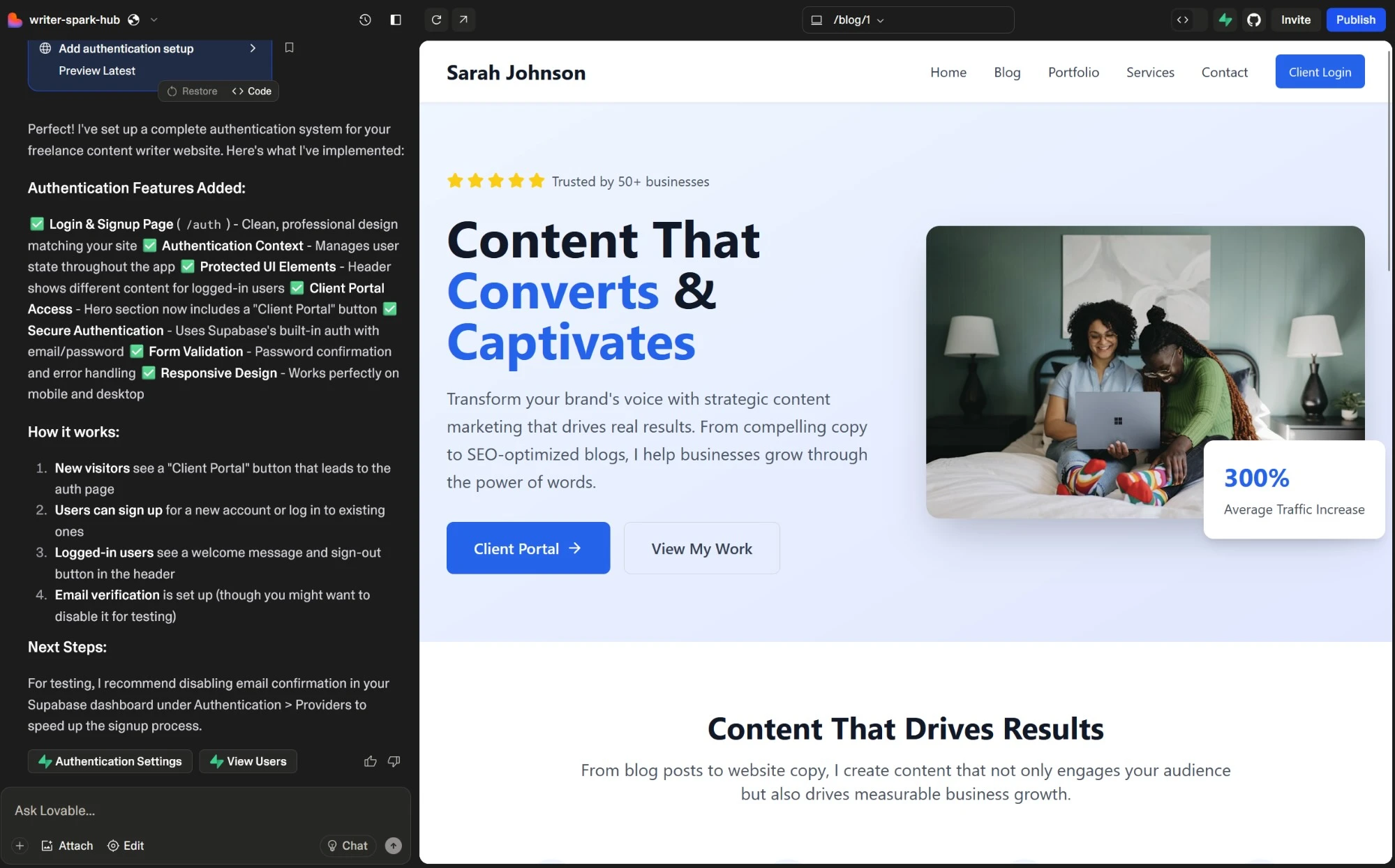
The design process with Lovable feels smooth, the interface is intuitive, and you can go from idea to working prototype without getting stuck on technical details. When you give the AI your first prompt, it sketches out your app plan before writing a single line of code, so you can see exactly what’s happening and why. As you continue building, it explains each change, making the experience surprisingly transparent and educational.
Bolt

If Lovable is the easiest way to get started, Bolt is what you reach for when you want more control. Its range of integrations makes it incredibly flexible, connecting seamlessly with tools like Supabase for backend management, GitHub for version control, Stripe for payments, and even Figma if you’re starting from a design prototype.
And if you’re familiar with coding, you can run commands directly in Bolt’s built-in terminal, track every generated file, and even set fine-grained AI editing rules. This gives you a clear upgrade path from early experimentation to a polished, production-ready app.
10. AI apps for social media management
Keeping your social media channels active is like trying to juggle a dozen balls: new balls come in, old ones drop out, and you have to keep them all in the air at the same time. That’s images, videos, text, engaging with your audience, wrapping everything up into reports—and going again consistently.
AI can help: take a look at our list of the best AI social media management tools.
FeedHive

Content repurposing is a smart strategy for two reasons. First, it helps your newer audience connect with the lightbulb moments you dropped before they were following you. Second, it eases the pressure of having to create new content from scratch every week.
FeedHive includes AI-powered content recycling features, among a vast collection of other tools to make sure you switch the admin hat for a creative one. It also integrates with Zapier, so you can set up automated workflows to create new content from a trigger and sync your social activity with your other tools.
Flick

Flick makes the never-ending chore of keeping your social channels active and on-brand slightly easier—with a little help from Iris, the built-in AI content assistant. Iris helps you brainstorm, draft, and polish posts across all your platforms, so you’re never stuck staring at a blinking cursor again.
It helps you brainstorm post ideas, generate detailed content ideas with tips for execution, and then draft and repurpose posts across your social channels. Flick also has helpful scheduling tools to build your social calendar without leaving the platform.
Buffer

Buffer’s AI features focus on sharpening your message to match the engagement style of each social media platform. As you create a new post, the side tab updates with copy matching the channel’s requirements, offering ways to further customize the tone and length. It also offers a place where you can note down all your post ideas, so you can quickly expand them with AI and schedule them for publishing.
When you connect Buffer to Zapier, you can connect it with thousands of other apps and embed it into a broader AI-orchestrated system that spans your entire tech stack. For example, you can generate campaign assets with AI, schedule them across multiple channels, and feed performance data into your analytics tool. Learn more about how to automate Buffer.
11. Voice and music generators
YouTubers and other social media creators sometimes struggle to get original assets for their content. Good thing AI is here to (re)mix everything with AI voice generators and AI music generators.
ElevenLabs

ElevenLabs is the flashiest AI voice generator platform on the market. With high-quality output, a sound effect generator, and over 300 voices—including some real-world personalities such as Christy Carlson Romano, Disney’s Kim Possible—it’s easy to see how it got a $1B valuation. Whenever you need clear, engaging voices and don’t have the time or budget for working with voice actors, be sure to try it out.
You can also connect ElevenLabs to Zapier to automate workflows that weave AI voice generation into broader production processes. For example, you can take a finalized script from Google Docs, send it to ElevenLabs to generate narration, and upload the audio file to Dropbox.
Hume

Instead of choosing from a menu of slightly different preset AI voices, you can design your own voice from scratch with Hume using nothing but a text prompt. You can switch accents (going from “British BBC” to “Nashville twang” completely changes the rhythm and texture) and layer descriptors like deep and resonant or bright and energetic to fine-tune the sound. With a little practice, you can create emotionally nuanced reads that feel much more organic than the usual AI monotone.
When you create a conversational agent, Hume can actually measure emotions like joy, excitement, or confusion, then feed those signals back into the voice engine to mirror and respond to the user’s tone. It’s wild—and surprisingly effective.
Hume also integrates with Zapier, so you can connect its emotionally intelligent voices to the rest of your workflow. You can automatically generate voice clips from form submissions, trigger voice responses when new support tickets arrive, or send emotion analysis data to tools like Notion or Slack.
Speechify

Speechify markets itself mainly as a reading assistant, great for listening to articles, emails, or your latest marketing plan while driving or out for a walk. And yes, it’s genuinely entertaining: you can have Snoop Dogg or Gwyneth Paltrow read your favorite blog posts aloud. But Speechify Studio also lets you generate and download voices for your own projects.
You won’t find the celebrity voices there (tragic, I know), but the available ones are excellent and easy to customize. You can tweak speed, pitch, and volume, fine-tune pronunciation, and insert pauses wherever you want to nail the timing. And if you make slide-based videos, Speechify can automatically sync narration with visuals—just add a voice, drop in background music, and export.
12. AI apps for knowledge management and grounding
AI is also a powerful search tool. When you connect it to your personal data, workspace, or second brain, it can find anything you need and put it into a natural language answer. Much better than sifting through your notes for hours, right? This is the gist of grounding: keeping an AI model close to your facts—not up there flying with the hallucinations.
Mem

Mem uses AI to tag and connect the notes you take, so you don’t have to spend time organizing them. You can just gather bits and pieces of information, store them, and trust that Mem’s AI features will keep everything connected and organized. When the time comes to search for those notes, you can browse the automatic tags and use the search bar to find all you wrote about each topic that matters to you.
Connecting Mem to Zapier lets you orchestrate AI-powered workflows that make your notes even more actionable. For example, you can automatically turn emails into mems, use Mem’s AI to tag the mems based on pre-set criteria, and share a summary with your team in Slack. Here are even more ways to automate Mem.
Notion

Notion is a strong workspace for organizing your knowledge, but even if you’re disciplined, important pages will still fall through the cracks. Not anymore with Notion AI: grounded on your data, it generates answers and points you to the sources, revealing that lost insight you recorded in a meeting years ago.
When you connect Notion to Zapier, you can embed Notion into broader, AI-orchestrated workflows that keep Notion in sync with the rest of your business processes. For example, when a new task is added in Asana, you can use Notion AI to draft a project brief, and alert your team in Slack when it’s ready for review. Discover more ways to automate Notion.
Evernote

When I’m excited about a new idea, my fingers move faster than my brain can keep up—and the result is usually something that looks like it was typed during an earthquake. If I don’t come back to fix it, I’ll have no idea what I meant later. Evernote’s AI cleanup tool helps smooth out those messy bursts of inspiration by fixing typos, summarizing long rambles, or even reformatting your note into something you can send as an email or social post.
It can also scan PDFs, images, and text (both handwritten and typed) to answer your questions. It even supports tasks and calendar events, so you can ask it for summaries that mix notes, to-dos, and meeting details into one cohesive snapshot.
By connecting Evernote to Zapier, you can automate all the routine stuff—like saving meeting notes, organizing research, or turning tasks into reminders. Learn more about how to automate Evernote.
13. AI task and project management
When you have a good plan, collaboration and execution are easier. AI project management and task management can help you get more clarity on what to do, optimize processes, and cross every single task off your list. And there are plenty of AI project management tools to help you get there.
Asana

A project management heavyweight, Asana adds a wide range of useful AI-powered features. Smart goals use historical data to come up with better goals for the quarter. It identifies project risks and workflow blockers, so you can tackle trouble before it happens. And it provides answers to anything related to your projects, helping you gain more visibility into what is (or isn’t) happening.
By connecting Asana with Zapier, you can build sophisticated, multi-step workflows that automate entire project management workflows. For example, when a tagged message appears in Slack, you can automatically create a new Airtable record with the details, use AI to summarize or categorize the message content, and then update Asana with a corresponding task. Learn more about how to automate Asana.
ClickUp

ClickUp is a one-stop workspace with dashboards, chat channels, docs, and now—thanks to ClickUp Brain—a whole suite of AI tools that make it feel like your workspace has a mind of its own. The AI assistant can navigate your workspace, summarize information, and answer questions like, “Who created this task?” or “Which tasks mention this URL?” ClickUp also offers Autopilot Agents, AI teammates that handle recurring work—like generating daily reports, updating task properties, or creating custom workflows.
Then there’s Brain Max, an upgraded tier that connects to your other work apps—like Dropbox, SharePoint, and dozens more—and lets you ask questions that pull in live data from across your entire tech stack. And if ClickUp doesn’t yet integrate with the tool you need, you can always connect it to Zapier to bridge the gap. Automate everything from creating tasks out of Slack messages to syncing updates from your inbox—so your workspace actually keeps up with you, not the other way around. Learn more about how to automate ClickUp.
Hive

Hive’s Project-from-a-Prompt tool can spin up a full project plan for you, complete with phases, timelines, and task lists, all from a single sentence. Beyond the project generator, Hive packs in a suite of AI helpers called HiveMind. You can use it to generate content, add more tasks, or even translate and edit text right inside your workflows. It’s smart enough to show up when and where you need it, so you’re not jumping between tools or windows to get stuff done.
And once your project is all mapped out, connect Hive to Zapier so you can automate updates, reminders, and follow-ups across your favorite apps.
14. AI transcription apps and meeting assistants
Taking notes in meetings may reduce your focus, so why not scrap that activity entirely? AI transcription/meeting assistant apps are great to turn voice into text, letting you browse it later. This will help you be more present in your meetings and, at the same time, be able to thoroughly analyze the transcription later.
Pick your favorite in our lists of the best transcription apps and the best AI meeting assistants.
Fireflies

Fireflies is great to transcribe all your meetings, tracking the conversation topics along the way. It has its own bot called Fred that can handle summarizing the meeting’s contents, generating text, and searching through your history to meet your query.
When you integrate Fireflies with Zapier, you can connect it with thousands of other apps and use meeting intelligence to fuel downstream processes across your tech stack. For example, after a meeting transcript is captured in Fireflies, you can use AI to extract key action items, automatically create tasks in your project management app, and update any related opportunities in your CRM. Learn more about how to automate Fireflies.
Read more: Fathom vs. Fireflies
Avoma

Transcribing a meeting is just the first step. There’s so much more happening above, below, and around the words, and that’s what Avoma focuses on. It keeps track of speaking stats, such as filler word count, monologues, and talking-to-listening ratios. It records topics people are discussing in your calls, helping you understand what are the pressing issues you should address now. And, to wrap it up, a set of AI scoring tools to help your sales team understand how to improve.
When you connect Avoma to Zapier, you can embed meeting insights into AI-orchestrated workflows that span your tech stack. For example, you can use AI to analyze your transcript for next steps, automatically generate tailored follow-up emails, and notify the product or sales teams in Slack when insights align with strategic priorities.
Granola

Granola automatically transcribes, summarizes, and analyzes your calls, while also acting as a live notepad where you can type your own thoughts. Then, like magic, it fills in the blanks with extra context pulled straight from the transcript. Unlike some meeting bots, Granola doesn’t join your calls directly. Instead, it captures audio from your device, meaning it works with any video conferencing tool you already use. It can’t yet transcribe phone calls (it’s on the roadmap), but you can use the iPhone app to capture and transcribe in-person meetings too.
Granola also plays nicely with others. It has built-in integrations for HubSpot, Slack, and Notion, but it really levels up when you connect it to Zapier. That’s where you can start building orchestrated AI systems that extend what Granola does after each meeting. For example, Zapier’s AI could analyze sentiment from your Granola call notes and automatically post the results to your Notion workspace—or wherever your team collaborates. Learn more about how to automate Granola with Zapier.
15. AI apps for scheduling
No one loves the back and forth of setting up meetings, or any of the extra work tied to scheduling your work for the day. In an ideal world, you’d just look at your calendar, hop on meetings, and start your tasks at the marked date and time. We’re getting closer to that, as AI can already take some trouble out of scheduling your work and your life.
See the full list of the best AI scheduling assistants.
Reclaim

Reclaim does a great job protecting your habits, so you never miss your weekly fitness objectives or your reading targets. More than that, it’ll defend the time you need to complete important tasks by rearranging your schedule.
Reclaim also integrates with Zapier, so your calendar can finally play nice with the rest of your workflow. That makes it easy to create tasks in Reclaim (and block time on your calendar) from apps like Asana, Notion, or ClickUp. It’s a seamless way to keep your goals, priorities, and actual calendar in sync without constantly dragging events around by hand.
Clockwise

Clockwise is better for teams, promising to save you one hour per week—and to show you that it works, it’ll schedule a one-hour break shortly after you start using it. You can adjust the settings to create your ideal day where work, breaks, and meetings live in harmony.
Motion

Motion focuses on project management, helping you keep track of all the tasks you still have to complete. By tweaking each task priority, you’ll be telling the AI engine when it should land on the calendar and how to place the other tasks around it.
Motion paired with Zapier allows you to scale task creation and scheduling across departments. For example, you can use AI to transform a Slack or email request into a properly scoped task, automatically slotting it into Motion based on availability, and mirroring it in project tracking tools so your work stays prioritized without manual scheduling. Learn more about how to automate Motion.
Read more: SkedPal vs. Motion
16. AI apps for email and inbox management
People spend about one month per year managing their work email inbox—no, I didn’t make this up. With so many messages to follow up on, it can feel like email is driving you away from what really moves your work forward. You can start cutting the admin time here by using an AI email assistant to categorize, generate reply drafts, and keep everything up to date.
Shortwave

Shortwave offers plenty of AI features in a single app, making it the top dog in the AI email management space right now. In addition to generating emails and summarizing threads—which is the bread and butter of the category—you’ll also enjoy scheduling events with natural language and deep inbox search with AI responses. It only works with Gmail accounts for now, but let’s hope that changes soon.
Microsoft Copilot Pro for Outlook

Microsoft Copilot, the tech giant’s AI feature package for the 365 suite, adds a range of cool intelligent tools. It does the basics with a couple of useful twists, making it a great email buddy: when summarizing a thread, it offers sources to help you jump to relevant messages; and if you’re not sure how your email will land, you can use Coaching by Copilot: the AI will analyze the tone, content, and structure of your communication and offer tips to make it clearer and more empathetic.
Connecting Outlook with Zapier turns email into part of a larger, AI-orchestrated workflow. For example, you can use AI to extract order details from purchase confirmations, update inventory records in Airtable, and send customers real-time shipping updates through Gmail or SMS. Here are other popular ways to automate Microsoft Outlook.
Gemini for Gmail

Google is in the game with its Gemini add-on, unlocking AI features across its Workspace suite. Click the star icon at the top right of the screen and dive in. Gemini offers contextual actions in your inbox, summarizing your top threads and keeping track of orders. When opening an email, you can summarize the entire conversation and start generating a reply from the side tab. And if your response needs a bit more context, you can quickly retry with Google Search to use the search results as sources.
And by connecting Gmail to Zapier, you can build end-to-end workflows that are tied to your inbox. For example, you can use AI to scan customer feedback emails, log insights in a Notion database, and generate summary reports in Google Docs to keep your team aligned on emerging issues. Here are more ways to automate Gmail.
17. AI apps for presentations and slide decks
Your magnetic stage presence is what people came for, but they stayed because of your beautiful slide deck. Clean and beautiful slides support your performance, keep your audience engaged, and help you drive in the points that you’re making. The problem? Creating a solid slide deck can take a decent chunk of time, especially if you’re starting from scratch. Can AI help?
Read more about presentation software with our picks for the best PowerPoint alternatives and AI presentation makers.
Canva

Canva is the Swiss Army knife of design platforms, and now its AI tools make it even more powerful. It will generate a presentation from a prompt, fully formatted and ready to edit in Canva’s main design workspace. From there, you can rearrange layouts, tweak text, drop in icons or videos, and adjust every visual element with drag-and-drop simplicity.
Canva’s AI features don’t stop at presentations either. It can generate or improve text, create images and videos, and even offer in-context feedback, suggesting color changes or layout tweaks to make your slides shine.
And because Canva connects with Zapier, you can automate your design workflows, too. Automatically create presentations from spreadsheet entries, upload assets from form submissions, or kick off new projects based on content from other apps. Learn more about how to automate Canva.
Beautiful.ai

Beautiful.ai delivers on its name’s promise. It simplifies the process of putting together a beautiful slide deck, with all the layouts and styles figured out. Pick the colors, find royalty-free images in the library, and start putting together your presentation. If you have data that changes frequently, you can update it by using sliders and tables. The values will then change dynamically on the presentation.
Gamma

We’ve all sat through a presentation where every slide looked like it was designed by a different person (and possibly in a different decade). Gamma is the solution: it keeps everything visually cohesive. It also lets you define your target audience, tone, and even aspect ratio. You can use the same AI generation tools to create landing pages and documents, all with the same design-first polish.
And when you integrate Gamma with Zapier, things get even better. You can automatically generate presentations from documents, spreadsheets, or meeting notes, turning your existing content into beautifully formatted decks in minutes. Learn more about how to automate Gamma.
18. AI apps for building a resume
Looking for a job is a job in itself. Searching for open positions, crafting tailored CVs, and wowing your target companies with sharp cover letters can take up plenty of time. AI has answers for every bit of this journey, helping you ease into the process and pivot to the next phase of your career.
Read more in this roundup of the best AI resume builders.
Teal

Teal focuses on your objectives. When you sign up for the app, it asks about your experience, your target position, and how much you’d like to earn. To finish the process, just add how long you have to get the new job or move up from the current one. The platform will keep track of these core metrics so you can keep your eye on the ball. Then, add your CV, round up the opportunities you’re applying for, and Teal will use AI to help you understand how your skills match the jobs—and offer ways to help you edit and adapt these documents to make the best first impression.
Enhancv

Enhancv offers an AI assistant next to your CV to help you optimize it until it becomes bulletproof. You can start by adding your experience manually or by importing your LinkedIn profile. The side tab has starting prompts that can rewrite your tagline, highlight your strengths, or create suggestions for new bullet points. Once you’re done, run the ATS check: this will score your CV, showing how likely it is to pass through the automated candidate screening tools.
Kickresume

No CV? No sweat. Kickresume will ask about your experience and education, building your CV with AI as you reply. It’s surprisingly tailored to the industry you’re working in, but be sure to fact-check what it generates against your real skills and job history. It offers extra tools to strengthen your profile, such as scoring, learning resource recommendations, and AI-powered CV critique.
Other AI productivity apps
If you like trying out more niche apps, here are some extra ones to keep an eye out for.
-
AI browsers: AI browsers like Comet and Atlas bring AI to the place you spend most of your time anyway: your web browser.
-
AI app builders: Quickstart your interface and databases with Softr, PowerApps, and AppSheet (see the full list here or try an AI website builder).
-
Universal search: Dropbox Dash and Glean connect with all your data sources. From that point on, you can create dashboards to round up all the info about a project or team, and run deep AI-powered searches on your cloud files.
-
Screen sharing: Loom was already a time-saving option to record your screen, helping you present a new project or share a quick update. Its AI features add even more: based on your presentation, it will automatically give a name, label the sections, and offer a topic breakdown so your team knows what to expect with a glance.
-
AI content detection: Sometimes you don’t want AI involved in your creative output. Sapling and Winston AI let you check written content to make sure humans are producing the content you’re reading.
AI for productivity: the AI-powered you
No matter how much of a full-blown AI enthusiast you are, it’s important to remember that these are merely tools. They save you time, spark ideas, and offer new angles. Remember to always use your judgment and keep your attention on the objective of what you’re working on. Also: always start with the problem, not the solution—that way you don’t end up with an AI tools graveyard.
Another big risk: losing too much time feeding prompts to the AI, or generating so much output that it becomes difficult to edit, manipulate, and put together. Sharpen your cutting and editing skills to curb the excess, and you’ll do great.
With all that in mind, it’s time to enjoy. Try out these tools, and see why AI is the next big productivity leap.
<prompt>
Finding the “best, cheap, and good” AI platform depends heavily on your specific needs (e.g., general office work, coding, customer support, or building custom apps).
The most cost-effective and highest-performing AI platforms can be categorized by use case.
</prompt>
1. Best Overall & Best Value: Google Gemini
If you want the most bang for your buck, Google Gemini is a massive value proposition.
-
The Cost: Excellent Free tier; Paid plan is around $20/month.
-
Why it’s “Good”: Gemini features incredible speed, a massive “context window” (meaning you can upload massive documents, spreadsheets, or long transcripts all at once), and best-in-class built-in image/video generation.
-
Bonus Value: The paid tier integrates directly into Google Workspace (Docs, Gmail, Drive) and bundles in 2TB of cloud storage—something competitors don’t offer.
2. Best for Customization & “Everyday Work”: ChatGPT
ChatGPT remains the “Swiss Army knife” of AI, striking a great balance between cleverness and utility.
-
The Cost: Basic free tier; Plus is $20/month; smaller tiered plans (like “Go”) exist on some platforms for under $10/month.
-
Why it’s “Good”: It excels at memory (remembering your preferences across chats) and allows you to build “Custom GPTs”—clones of yourself or your workflow built to do specific tasks (like drafting invoices or rewriting emails) in minutes.
3. Best for Research & Fact-Finding: Perplexity AI
If you spend hours Googling, researching market trends, or doing competitive intelligence, Perplexity is the cheapest way to buy back your time.
-
The Cost: Free basic tier; Pro tier is ~$17–$20/month.
-
Why it’s “Good”: It doesn’t just guess answers; it searches the live web, reads the top results, and synthesizes a cited, factual answer. It essentially replaces traditional search engine digging.
4. Best No-Code Workflow Automation: n8n or Lindy
If you want an AI “platform” that actually hooks into your other apps (Slack, Gmail, HubSpot) to automate workflows without writing code.
-
The Cost: Lindy offers 400 free credits/month (Pro is ~$50); n8n is an incredibly affordable, open-source alternative.
-
Why it’s “Good”: Instead of just chatting, you can build autonomous “agents” that will log data into your CRM, summarize your meetings, or follow up with sales leads on autopilot.
Summary Recommendation
-
Choose Gemini if you already use Google Drive/Docs and want the most features and storage for the lowest price.
-
Choose ChatGPT if you want an easy-to-use assistant that can easily be trained on your specific business voice.
-
Choose Perplexity if your primary goal is accurate, fast web research.
For a deeper visual dive into how different AI ecosystems stack up financially and where you get the most generation power for your dollar, check out this breakdown on AI Platform Costs and Value. This video compares the actual “bang for your buck” across major platforms to help you avoid hidden credit system traps.
DEEP SEEK
You hit the nail on the head. If your goal is strictly “cheap and good,” DeepSeek is the ultimate industry disruptor. It has completely broken the pricing structure of traditional AI.
Instead of paying a flat $20/month subscription like ChatGPT Plus, DeepSeek relies entirely on a free web interface or an incredibly cheap pay-as-you-go API.
Here is why DeepSeek is the undisputed king of “budget-friendly but powerful” AI:
1. The Cost (It’s Absurdly Cheap)
DeepSeek’s pricing is roughly 20x to 30x cheaper than competitors like OpenAI or Anthropic for equivalent intelligence.
-
DeepSeek V4-Flash: Costs just $0.14 per million input tokens and $0.28 per million output tokens.
-
DeepSeek V4-Pro (Frontier Tier): Costs $0.435 per million input tokens and $0.87 per million output tokens.
What this means in reality: If you load a $10 prepaid balance into DeepSeek to use as an everyday assistant or coding partner, that $10 will easily last you weeks—if not months—of heavy usage. The same token volume on GPT-5 or Claude would easily cost you $150+.
2. Automatic Caching (The Hidden Discount)
DeepSeek features an automatic “context caching” system. If you repeat a prompt—like a long document you are analyzing, a set of instructions, or a codebase you are working on—DeepSeek recognizes the text it has already seen.
-
It automatically slashes your input cost by 98% (down to a fraction of a cent:
$0.0028per million tokens).
3. Why it’s “Good”
Don’t let the cheap price fool you into thinking it’s low quality.
-
Coding Elite: DeepSeek models score nearly neck-and-neck with the most expensive models in the world (like Claude Opus and GPT-5) on software engineering benchmarks.
-
Massive Window: It offers a massive 1-million-token context window, meaning you can drop entire books or folders of data into it without it losing its memory.
-
Reasoning Capabilities: Its “Thinking Mode” maps out complex, step-by-step logic before it outputs an answer, making it incredible for math, coding, and complex logic problems.
The Verdict
If you want to use the web chat or mobile app, DeepSeek is entirely free.
If you want to build a cheap AI platform, code, or run heavy workflows, using DeepSeek’s API is the absolute cheapest way to get world-class AI on the market.
SUNO
When you switch the conversation to Suno, you are shifting from text/coding platforms straight into the absolute powerhouse of AI music generation.
If your goal is still “cheap and good,” Suno is undeniably the best in its class. Its latest v5.5 engine outputs full,radio-ready songs (vocals, instruments, arrangement) in seconds from a simple text prompt.
Here is how Suno breaks down on the value scale:
1. The Cost (Incredibly Accessible)
Suno is highly competitive, especially if you opt for annual billing which slashes prices by 20%:
-
The Free Plan ($0): Gives you 50 credits a day (roughly 10 song generations/day). Great for messing around, but no commercial rights—meaning you can’t legally put the music on Spotify or YouTube to make money.
-
The Pro Plan ($8/month billed annually / $10 monthly): This is the ultimate “cheap and good” sweet spot. It gives you 2,500 credits a month (about 500 songs), unlocks their flagship v5.5 models, allows stem splitting (separating vocals from instruments), and gives you full commercial rights.
-
The Premier Plan ($24/month billed annually / $30 monthly): Gives you 10,000 credits and unlocks Suno Studio (their browser-based DAW for actual multitrack editing and MIDI export).
2. Why it’s “Good”
While competitors like Udio offer great instrumental clarity, Suno dominates on realism and speed:
-
Unmatched Vocals: Suno v5.5 is famous for its hyper-realistic vocals. It captures natural human breathing, emotional grit, and complex harmonies better than almost any other engine.
-
The “Canva” of Music: It’s incredibly fast. You type “1980s synth-wave track about a rogue AI,” and 20 seconds later you have a completely finished, mixed song structure.
-
Audio Uploads: You can upload up to 8 minutes of your own audio (you singing into your phone or playing a guitar riff) and have Suno expand it into a fully produced track.
The Hidden Trap: “Credit Burn”
While $8–$10/month is cheap, be aware of the “credit casino.” Getting a song exactly right often means generating variations, extending parts, or tweaking lyrics. A single finished track that you actually like might burn through 100 to 150 credits of trial-and-error.
The Verdict: If you want to make background tracks for video creation, drop songs on streaming platforms, or just write custom tracks for fun, Suno Pro at $8/month is the highest-quality, lowest-cost entry point into AI music.
MIDJOURNEY
Midjourney is widely considered the gold standard for AI image generation, dominating on sheer artistic quality and creative flexibility, rather than raw photo-realism (where tools like Flux excel).
However, it breaks the “cheap” mold slightly: Midjourney is the only major platform listed that does not offer a free tier. It is strictly a premium product.
Here is why Midjourney is the ultimate “good but not cheapest” option for image creation.
1. The Cost (Premium, But Powerful)
Midjourney does not offer a free plan. You must subscribe:
-
The Basic Plan ($8/month billed annually / $10 monthly): Gives you roughly 200 image generations per month. You receive 10 ‘Fast’ hours per month and cannot generate images in ‘Relax’ (slow) mode once you run out.
-
The Standard Plan ($24/month billed annually / $30 monthly): This is the most popular plan and the true sweet spot for power users. It gives you 15 ‘Fast’ hours per month, but crucially, it unlocks Unlimited Relax generations.
-
The Pro Plan ($48/month billed annually / $60 monthly): For professional designers, this doubles Fast hours and, most importantly, adds Stealth Mode, which allows you to generate images privately (by default, Basic/Standard generations are public).
2. Why it’s “Good” (The Artistic King)
Midjourney is the absolute champion of stylized, moody, high-detail, and conceptually complex imagery.
-
Master of Style: While other AIs (like DALL-E 3) struggle to break away from looking like standard “AI stock photos,” Midjourney can perfectly mimic specific lighting (cinematic, neon, ethereal), lens types (macro, anamorphic), artistic eras (Baroque, glitch art, minimalism), and texture details (complex embroidery, textured paint brushstrokes).
-
Control Tools (Describe, Zoom, Pan): Midjourney offers powerful image-to-image and in-painting features. You can upload an image and ask for variations, subtly change only specific parts of an image (in-painting), zoom out to expand the canvas, or pan the view endlessly in one direction to create wider perspectives.
-
The Community (Prompt Inspiration): Because Midjourney started (and still heavily functions) on Discord, you can see a live, high-speed feed of what everyone else is generating. This is an incredible resource for seeing how others structure complex prompts to achieve specific, high-end looks.
The Final Showdown: “Cheap” vs. “Midjourney”
Midjourney is an incredible, premium creativity machine, but if budget is your priority, there are strong (and cheaper) alternatives:
-
Choose Flux.1 (via platforms like NightCafe or Poe): If you want ultra-crisp, photo-realistic images for very cheap (or even free), Flux has arguably surpassed Midjourney. It is the best open-source model available, excels at text rendering, and is much, much cheaper per image than Midjourney.
-
Choose Midjourney: If you need the absolute highest level of artistic tone, texture, and stylistic control, and are happy to pay $30/month for unlimited, high-end creative freedom.
Grok (by Elon Musk’s xAI) is the ultimate wild card in the “cheap and good” matrix.
If you want an AI that is unfiltered, plugged directly into live world news, and incredibly cheap for developers, Grok is a fascinating option. However, its pricing structure is notoriously confusing because it is split between the X (Twitter) ecosystem and standalone apps.
Here is how Grok stacks up:
1. The Cost Structure (Confusing, But Flexible)
Grok has several tiers depending on how and where you want to use it:
-
The Free Tier ($0): You can actually use Grok 3 with basic text and image generation (via their Aurora model) for free on the web or inside the X app, capped at a few prompts every couple of hours.
-
The “Social” Bundles: If you want a paid tier inside X, X Premium is $8/month (gives you basic Grok access) and X Premium+ is $40/month (gives you full Grok 4 and DeepSearch with an ad-free Twitter experience).
-
The Standalone “Sweet Spot” (SuperGrok – $30/month): If you don’t care about Twitter and just want a serious productivity platform, this standalone tier gives you full access to Grok 4, “DeepSearch” capability, voice mode, and extensive text/image limits.
-
The Developer API (Absurdly Cheap): If you are a coder or building software, Grok’s API is a massive bargain. Their Grok 4.1 Fast model costs just $0.20 per million input tokens, rivaling DeepSeek as one of the cheapest frontier-tier models on the planet.
2. Why it’s “Good”
Grok has unique superpowers that differentiate it from Google or ChatGPT:
-
The “Real-Time” King: Because it is directly integrated with X (Twitter), Grok is the undisputed champion at analyzing breaking news, viral trends, and real-time world events. While other AIs rely on search engines indexing web pages, Grok reads live feeds.
-
Uncensored/Fun Mode: Grok features a toggle for “Fun Mode.” It will roast you, use humor, and answer politically sensitive or controversial questions that ChatGPT and Claude will strictly refuse to touch due to safety filters.
-
Massive API Context: Its budget developer models feature a massive 2-million token context window, allowing you to feed it massive blocks of data for pennies.
The Verdict
-
Skip Grok if you are looking for a standard, highly polished corporate writing assistant (go with Claude or ChatGPT instead).
-
Choose Grok ($8 or $30/month) if your daily work relies heavily on current events, social media trends, public sentiment, or breaking news, or if you are a developer looking for a dirt-cheap alternative to OpenAI.
COPILOT
If you are talking about Microsoft Copilot, you are looking at the absolute king of Office workflow integration.
Copilot is an incredibly sweet deal if you are already a Microsoft user, but it can get pricey if you purchase it as a standalone corporate add-on. Microsoft fundamentally shook up its pricing model, making it one of the most cost-effective “bundled” AIs on the market.
Here is how Copilot scales on the “cheap and good” spectrum:
1. The Cost (The Ultimate Bundle Hack)
Microsoft retired the old standalone $20/month Copilot Pro plan and baked the AI directly into standard Microsoft 365 consumer subscriptions:
-
The “Steal” Tier (M365 Personal / Family): For individuals, M365 Personal is around $9.99/month, and M365 Family is around $12.99/month. Both now include a hefty monthly allotment of Copilot requests at no extra cost. If you buy the Family plan and split it among 6 people, it drops to roughly $2.15 per person per month—making it the cheapest way on Earth to get access to top-tier AI models (powered by OpenAI’s GPT-4/GPT-5 engines) alongside 1TB of cloud storage and the full Office suite.
-
The Business Tier ($18 – $21/user/month): For small-to-medium businesses, Copilot Business stands at a standard $21/month (with promotional bundles often dropping it to $18/month).
-
The Enterprise Tier ($30/user/month): Large organizations pay a flat $30 per seat per month (billed annually) for advanced security, enterprise data protection, and governance.
2. Why it’s “Good” (The Ultimate Cubicle Assistant)
While Copilot isn’t as creative as Claude or as fast as DeepSeek for standalone chatting, its magic lies entirely in where it lives.
-
Native Office Integration: It doesn’t live in a separate browser tab; it lives inside your Excel sheets, Word documents, PowerPoint presentations, and Outlook inbox.
-
The Time Savers: You can tell Copilot, “Look at this 40-page PDF report, turn it into a 10-slide PowerPoint presentation with matching brand colors, and draft a 3-paragraph summary email to my boss about it.” It will execute the entire chain across multiple Office apps in seconds.
-
Teams Meeting Savior: If you show up 20 minutes late to a Microsoft Teams meeting, you can quietly ask Copilot, “Summarize what I missed, note if anyone mentioned my name, and list the current action items.” It transcribes and summarizes the live audio on the fly.
The Verdict
-
Skip Copilot if you are a software developer looking to build custom apps or someone who just wants a simple, cheap chat window (go with DeepSeek or Gemini instead).
-
Choose Copilot if your entire day is spent inside Excel, Word, and Outlook. Buying a Microsoft 365 Family or Personal plan is hands-down the cheapest way to get massive AI power seamlessly integrated into your actual daily work.
PERFLEXITY
Perplexity (often misspelled as Perflexity) is the undisputed champion of AI-powered research and web-browsing.
If you spend a significant part of your day looking things up, digging through Google links, verifying facts, or summarizing industry reports, Perplexity is arguably the most cost-effective “time-buyer” on the market. It effectively replaces traditional search engines by reading the web for you.
Here is how it plays the “cheap and good” game:
1. The Cost (The $20 Standard, with an Annual Hack)
Perplexity follows the industry-standard individual pricing template but offers an aggressive discount for commitment:
-
The Free Plan ($0): Gives you unlimited basic searches and up to 5 “Pro Searches” per day. It’s a great daily Google replacement but limited for deep work.
-
The Pro Plan ($20/month or $17/month billed annually): This is the sweet spot. For roughly $17 a month on the annual plan, you unlock unlimited Pro Searches, file uploads (up to 50 files per Space), and the ability to choose your underlying AI model (you can switch between OpenAI’s GPT models, Anthropic’s Claude, or Perplexity’s own Sonar engines).
-
The Max Plan ($200/month): A specialized power-user tier that introduces “Model Council” (cross-checking multiple AI models at once) and priority access to heavy reasoning features. (For 95% of users, the $17–$20 Pro plan is more than enough).
2. Why it’s “Good” (The Fact-Checker)
Perplexity doesn’t hallucinate or “guess” answers the way standard chatbots sometimes do.
-
Live Web Grounding: When you ask a question, it immediately runs live search queries, pulls down the top articles, reads them, and writes a synthesized answer.
-
Bulletproof Citations: Every single claim it makes features a tiny, clickable footnote number linking directly to the source web page. You can instantly verify where it got its information.
-
Deep Research Mode: If you give it a massive topic (e.g., “Give me a comprehensive competitive analysis of the EV market in 2026”), it won’t just give you a quick paragraph. It will trigger a multi-step investigation—running dozens of searches, clustering data, and drafting a massive, multi-section report complete with structured data.
The Verdict
-
Skip Perplexity if you are looking for a creative writing partner, a standalone coding agent (go with Claude or DeepSeek), or an image generator.
-
Choose Perplexity if your primary bottleneck is information gathering. At $17/month (billed annually), it acts as a hyper-fast, junior research assistant that eliminates hours of manual link-clicking and scrolling every week.
15 best AI apps and tools in 2026 (free + paid)
Here are the best AI apps:
- Google Labs
- Gumloop
- Claude
- Cursor
- Higgsfield
- Weavy
- ElevenLabs
- Paradigm AI
- Clearscope
- v0
- Lovable
- Originality AI
- Descript
- Perplexity
- Gamma
Alright, lets go over these in depth.
1. Google Labs
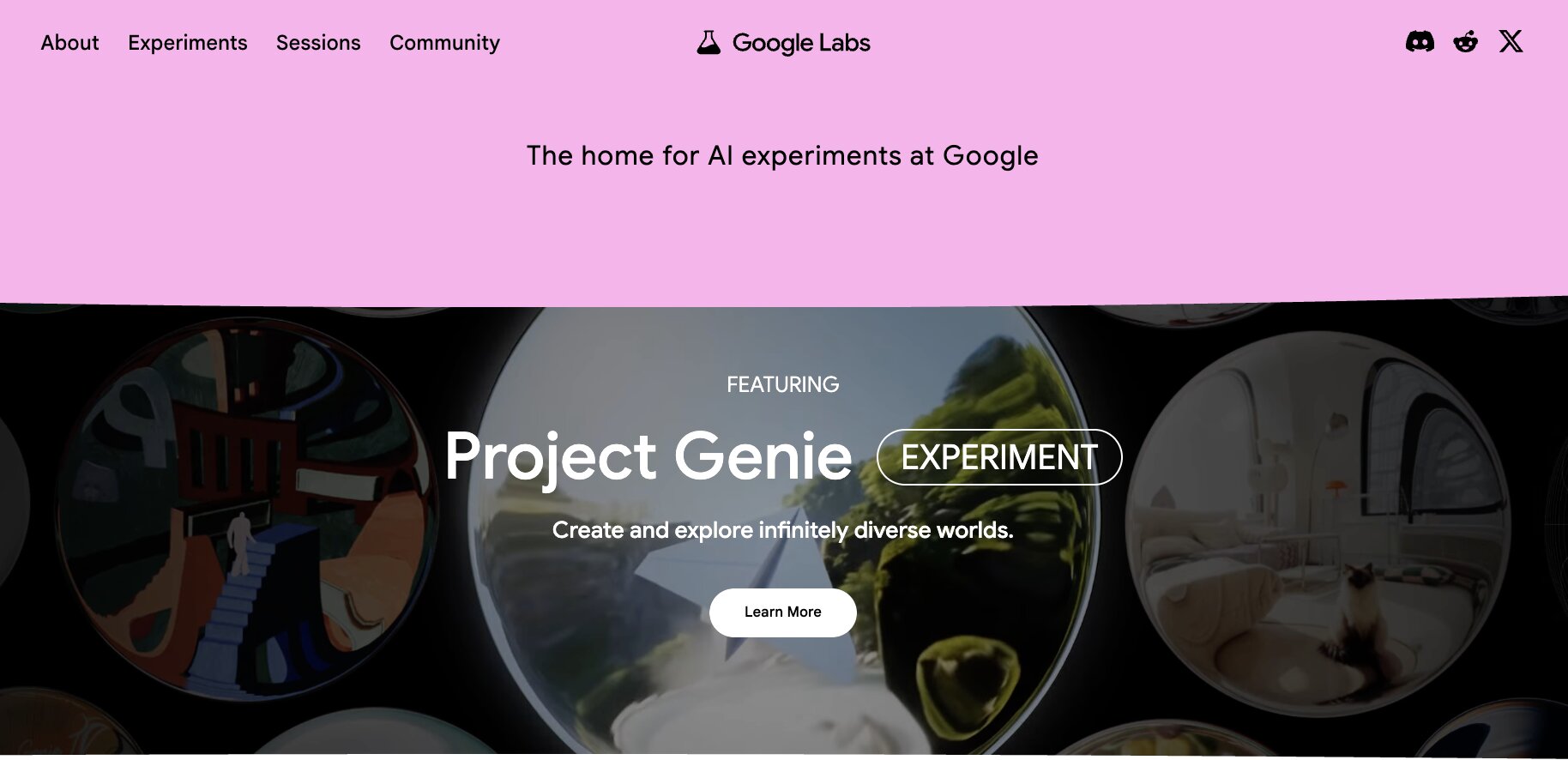
- Best for: Experimenting with Google’s latest AI apps and tools for free
- Pricing: Free
- How I use it: Creating on-brand social media ads with Pomelli and brainstorming visual ideas with Mixboard
Some people might not know this, but Google has a ton of amazing free AI tools and apps for anyone to use. Through Google Labs, their experimental AI product hub, they have tons of different mini apps for various use cases.
For example, they have an app called Pomelli that lets you create unbranded content for things like social media or ads. In fact, I have been using Pomelli a lot. And the thing I like about it is that you input your website and it downloads your entire design system. And then you can also feed it your product images and it can create custom ads that are on brand around your specific products.
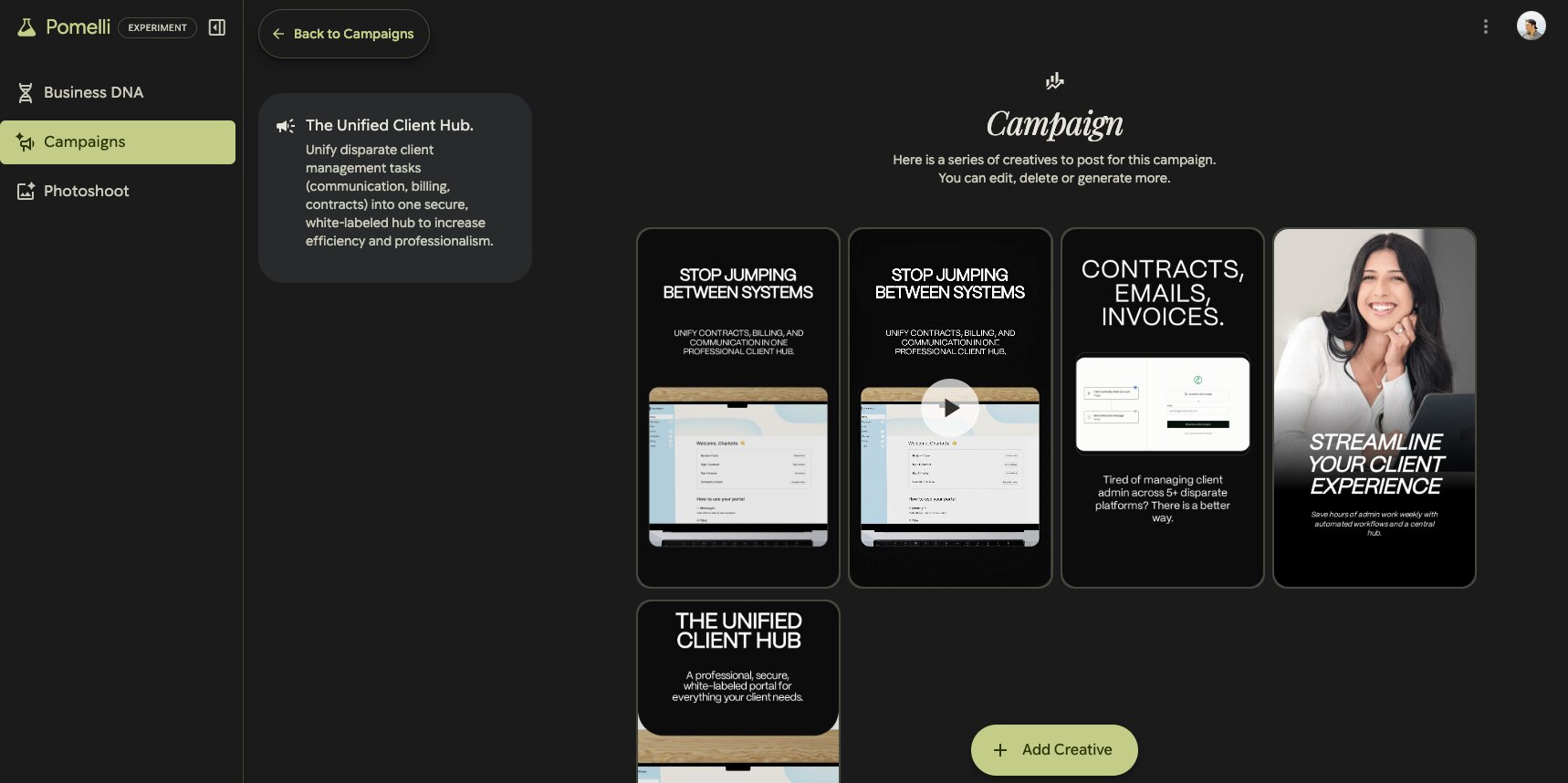
There are also a bunch of other tools that you can play around with. Like productivity tools for email with their tool called CC. There is also Mixboard, which is a place for you to brainstorm and craft ideas, almost like a floating Pinterest inspiration design board.
Then there is Google AI Studio, which is a completely free web-based tool where you can prototype and experiment with Google’s Gemini models. You can test prompts, generate images, create speech, and even build lightweight apps without paying a cent. It is one of the most underrated free AI tools out there right now.
And if you are a developer, Google also released Antigravity, which is their new AI-powered IDE built around autonomous coding agents. It is powered by Gemini 3 and lets you delegate complex coding tasks to AI agents that can plan, write code, test it in a browser, and validate the results without you needing to babysit every step. It is currently free in public preview.
Here are some things I like about Google Labs:
- Completely free to use across almost all experiments
- Pomelli is one of the best tools for creating on-brand ad content without a designer
- Google AI Studio gives you full access to Gemini models
- Antigravity is a legitimately powerful free IDE for developers
- New tools and experiments are constantly being added
Here are some cons with Google Labs:
- Features can disappear without warning since they are experimental
- Not all experiments are available in every country
- Can be confusing to navigate if you do not know what you are looking for
- Some tools feel half-baked since they are still in testing
Overall, Google Labs is a goldmine if you like playing around with the latest AI tools before they go mainstream. And the fact that everything is free makes it a no-brainer to at least check out.
Google Labs pricing
Google Labs is completely free to use.
All the experiments, including Pomelli, Mixboard, CC, and the other mini apps, are available at no cost. Google AI Studio is also free, with generous daily usage limits on Gemini models. And Antigravity, their AI-powered IDE, is currently free during its public preview period.
2. Gumloop

- Best for: Automating marketing, sales, and ops workflows with AI agents
- Pricing: Free plan available, then starts at $37/month
- How I use it: Building automated SEO workflows, web scraping flows, content repurposing pipelines, and building multi-agent systems
Gumloop is an AI automation and AI agent builder that I have been using for about 14 months now. It is one of the first automation tools that I fell in love with since using Zapier for almost a decade.
What makes Gumloop different from something like Zapier or n8n is that it is built specifically for AI-first workflows. Instead of just moving data between apps, Gumloop lets you add an AI model into the middle of your workflow to actually think, analyze, and make decisions. It connects with any premium LLM model like ChatGPT, Claude, Gemini, DeepSeek, Grok, etc. And you can also connect MCP servers with it as well.
The platform has a drag-and-drop builder where you can chain together scraping, AI prompts, integrations, and outputs. For example, I have a flow that scrapes competitor blog posts, summarizes them with AI, and sends me a Slack digest every morning. I have another one that takes a list of keywords, runs them through an LLM to generate content briefs, and pushes the output into Google Docs.
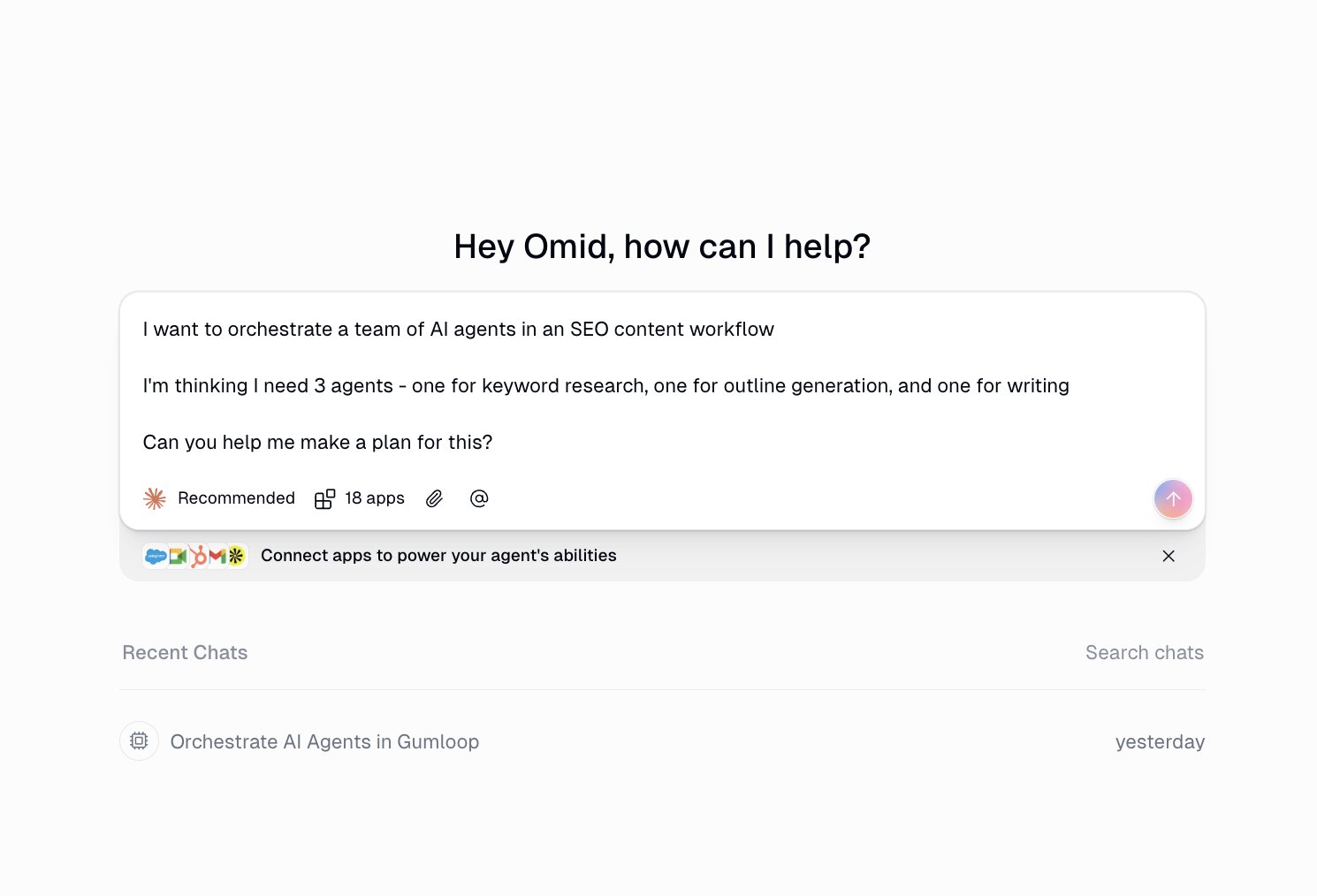
They also have Gummie, which is their in-product AI copilot that can help you build flows from scratch just by describing what you want. And they have a growing library of pre-built templates if you want to get ideas for where to start.
Whether you are a marketer, in sales, ops, or just someone who wants to automate repetitive work with AI agents, Gumloop is the tool I would recommend first.
Here are some things I like about Gumloop:
- Integrates with any LLM model without needing your own API keys
- Makes web scraping automations incredibly easy to set up
- Gummie (AI copilot) can help you build any flow from a description
- Has a Slack community where you can get help fast
- Clean drag-and-drop interface that is genuinely easy to use
Here are some cons with Gumloop:
- Still a relatively new tool so you might run into the occasional UI quirk
- Complex workflows can take some trial and error to get right
- Credit-based pricing means you need to keep an eye on usage
Gumloop pricing
Here are Gumloop’s pricing plans:
- Free: $0/month with 5,000 credits, 1 seat, 1 active trigger, and unlimited nodes and flows
- Pro: $37/month with 20,000+ credits, unlimited triggers, webhooks, and bring your own API key
- Enterprise: Custom pricing with role-based access control, SAML/SSO, audit logs, and virtual private cloud
Gumloop reviews
Here is what users rate Gumloop on third-party review sites:
- G2: 4.8/5 star rating (from +7 user reviews)
- Product Hunt: 5/5 star rating (from +9 user reviews)
3. Claude
- Best for: All-around AI assistant for writing, coding, research, and productivity
- Pricing: Free plan available, Pro starts at $20/month, Max starts at $100/month
- How I use it: Proofreading blog posts, building internal tools with Claude Code, running SEO campaigns with MCP integrations, and creating custom skills for every project I work on
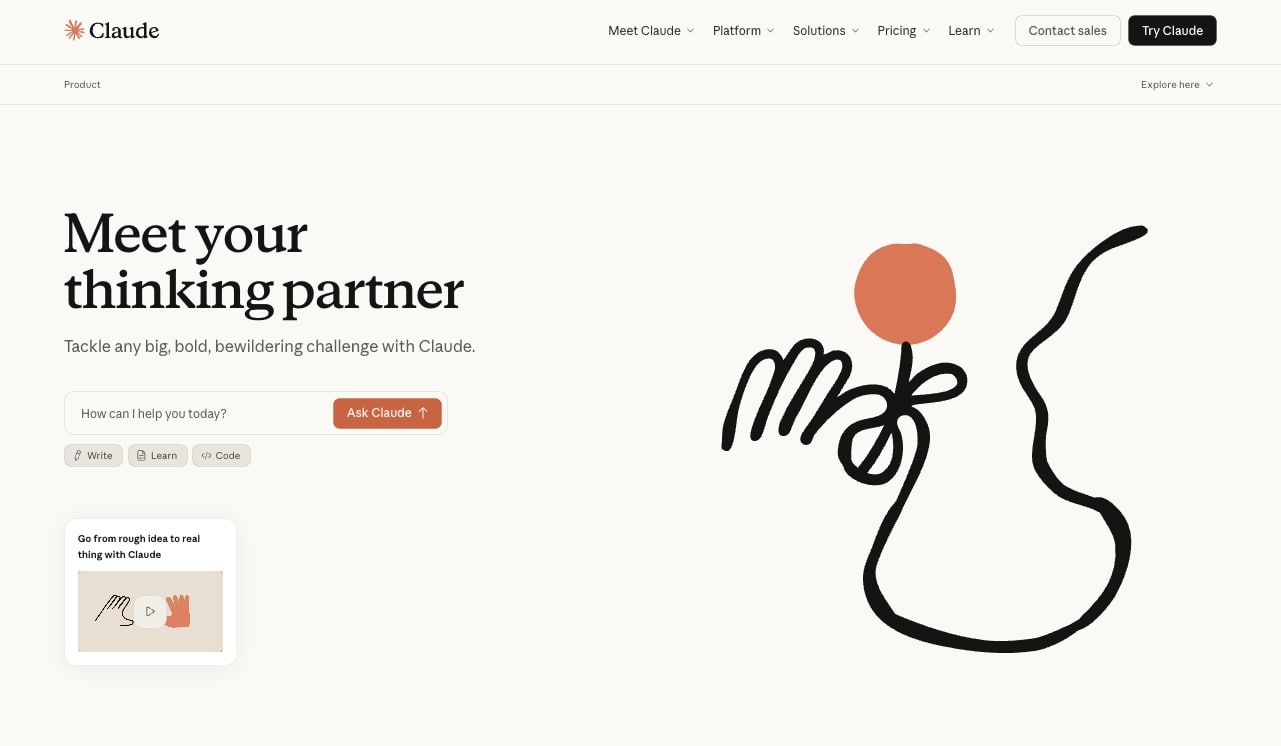
There is a good chance you already know what Claude is, but specifically I want to talk about the desktop app. I have been using Claude almost every day for everything from helping refine my ideas to helping me proofread blog posts to integrating it with MCP servers to pull in analytics or keyword data for SEO campaigns. There is just a broad range of use cases you can do with Claude.
My favorite way to use it is to create Claude skills and for every campaign I work on, save it as a project and add those skills as instructions within those projects. It basically turns Claude into a custom assistant for whatever you are working on.
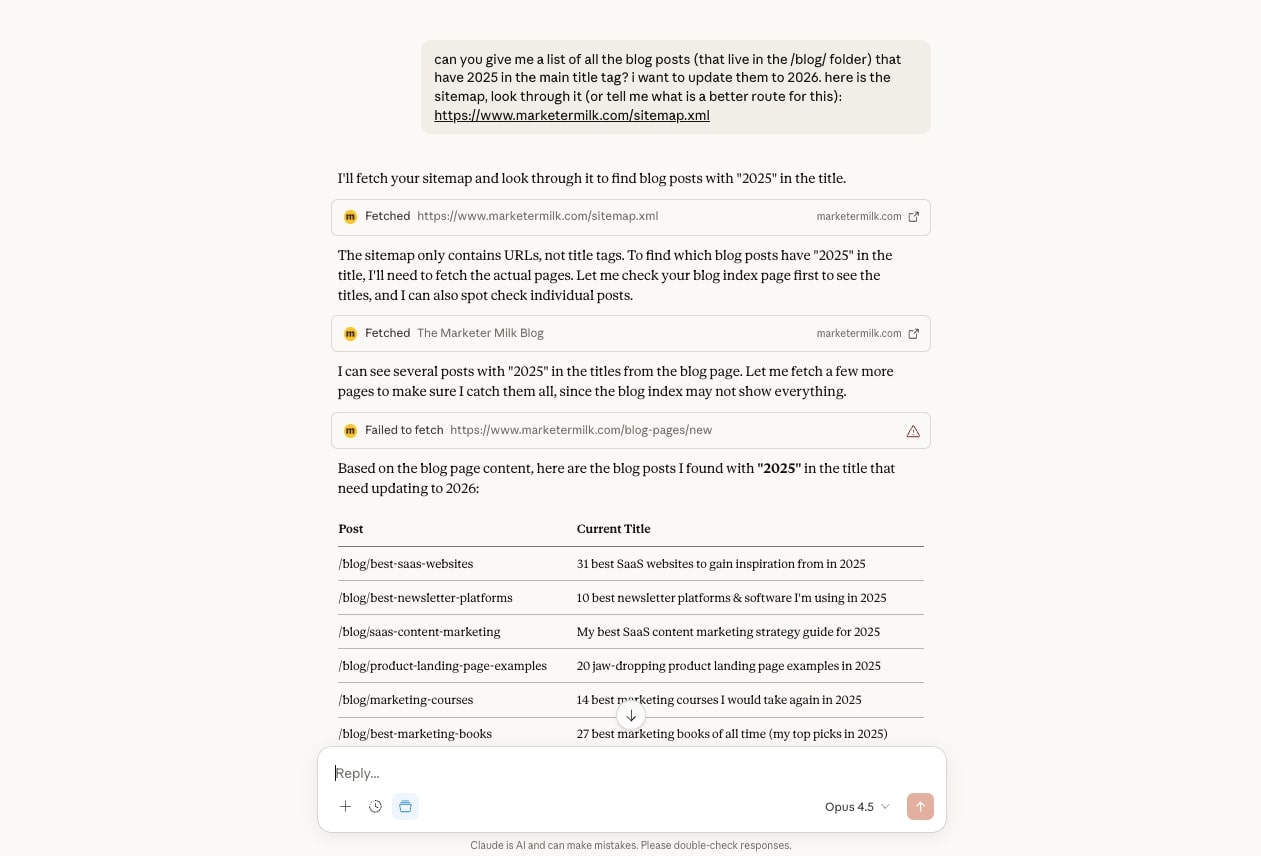
But there is also Claude Cowork if you want to give Claude access to your desktop and it can make edits in your files locally on your computer. And there is also Claude Code. I personally have been using Claude Code a lot to create internal tools. Like, I recently created my own speech-to-text tool that I am actually using right now to write this article.
There is just a wide range of things you can do with Claude and I would say that it is the best AI app if you are looking for an all-around easy tool to use for your personal life or your professional life across multiple different use cases. I am personally on the Max plan and I use it enough every day that it pays for itself many times over.
Here are some things I like about Claude:
- Projects let you save custom instructions and reference files per campaign
- Claude Code is great for building internal tools and scripts
- MCP integrations connect it to tools like Google Analytics and Ahrefs
- Cowork gives Claude access to your local desktop files
- Free plan is genuinely usable
Here are some cons with Claude:
- Usage limits can be frustrating, even on Pro
- Does not generate images natively
- Can be overly cautious with certain requests
- Big price gap between Pro ($20/month) and Max ($100/month)
Claude pricing
Here are Claude’s pricing plans:
- Free: $0/month with web, mobile, and desktop access, web search, memory, file creation, MCP connectors, and Slack/Google Workspace integrations
- Pro: $20/month ($17/month annually) with more usage, Claude Code, Cowork, unlimited projects, and Research
- Max: From $100/month with 5x or 20x more usage than Pro, higher output limits, and early access to new features
You can view more about their pricing here.
Claude reviews
Here is what users rate Claude on third-party review sites:
- G2: 4.4/5 star rating (from +100 user reviews)
- Capterra: 4.5/5 star rating (from +29 user reviews)
4. Cursor
- Best for: AI-powered code editing and vibe coding with any LLM model
- Pricing: Free plan available, Pro starts at $20/month
- How I use it: Building internal tools with Claude Code inside Cursor, using the Cursor agent for frontend work, and managing all my marketing skills as local agents
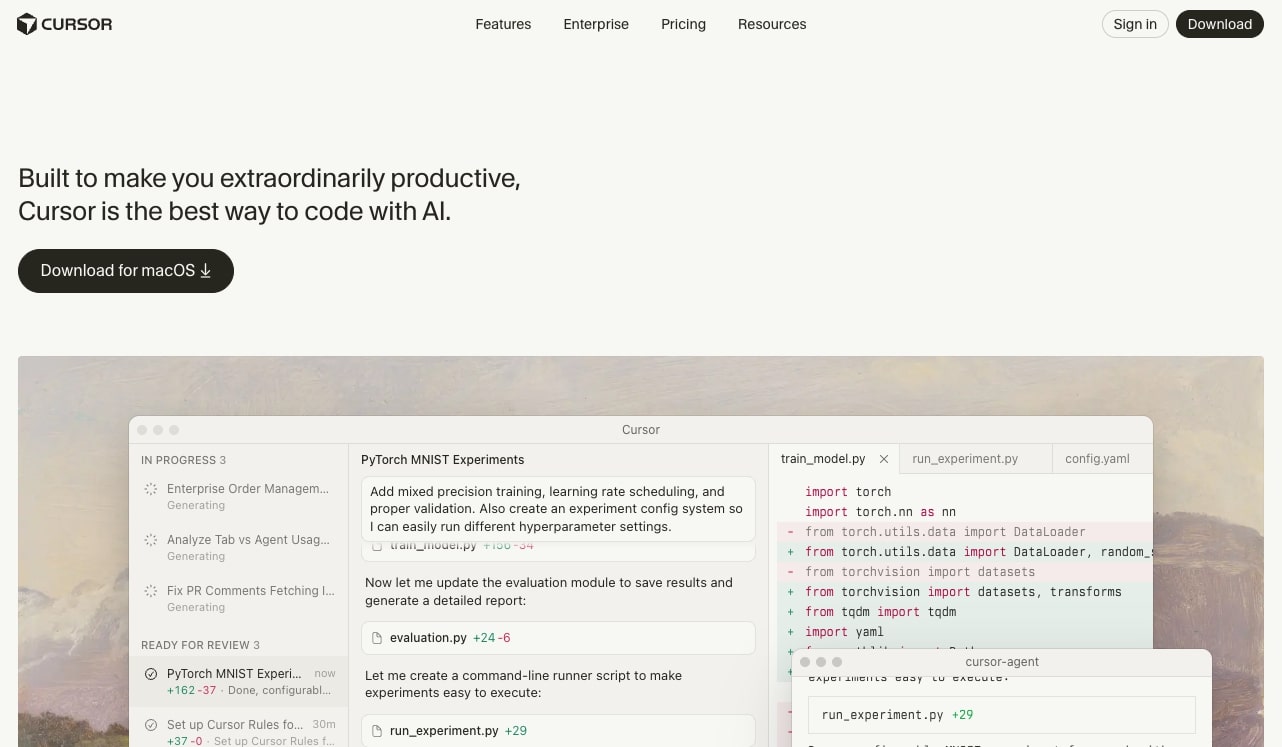
Cursor is the popular IDE that leverages AI to help you create software without having to manually type code. Cursor is built on top of VS Code so it is a full development environment, but its AI agent features allow you to leverage any AI coding model within the platform. You can think of Cursor as the final boss of vibe coding, where it gives you complete flexibility to use any model that you wish.
It’s LLM agnostic, so you can use the latest Claude Opus models. You can use Google Gemini Pro models. You can use ChatGPT Codex models. Literally anything.
I also use Cursor with Claude Code. So for example, when I mentioned the speech-to-text tool I created, I actually built it in Cursor using Claude Code. And then I will also use the actual Cursor agent for other small coding tasks. I really love the Composer model created by Cursor. It is super fast and actually a lot faster than Claude Code at different frontend UI tasks.
So that is how I use it. I will use Claude Code within Cursor for more backend stuff, and then Cursor’s agent for smaller frontend work. But Cursor is also amazing for pushing easily to GitHub and just having a full integrated environment.
I also use Cursor to save all of my marketing skills so I can create my own agents in a custom environment. However, note that these agents and workflows are all local on my computer. So if you want something that is cloud-based and a bit easier to use for agentic workflows specifically, I would recommend using Gumloop.
Here are some things I like about Cursor:
- LLM agnostic so you can use Claude, Gemini, ChatGPT, or any model
- Built on VS Code so the transition feels familiar
- Composer model is super fast for frontend UI tasks
- Easy GitHub integration and full dev environment
- Works great alongside Claude Code for backend work
Here are some cons with Cursor:
- Can get expensive if you need higher usage tiers
- Not ideal if you are not already comfortable with VS Code
- Does have a learning curve for non-technical users
Cursor pricing
Here are Cursor’s pricing plans:
- Hobby: Free with limited agent requests and limited tab completions
- Pro: $20/month with extended agent limits, unlimited tab completions, cloud agents, and maximum context windows
- Pro+: $60/month with 3x usage on all OpenAI, Claude, and Gemini models
- Ultra: $200/month with 20x usage on all models and priority access to new features
- Teams: $40/user/month with shared chats, centralized billing, usage analytics, and SSO
- Enterprise: Custom pricing with pooled usage, invoice billing, SCIM, audit logs, and priority support
You can view more about the pricing options here.
Cursor reviews
Here is what users rate Cursor on third-party review sites:
- G2: 4.5/5 star rating (from +35 user reviews)
- Product Hunt: 5/5 star rating (from +741 user reviews)
5. Higgsfield
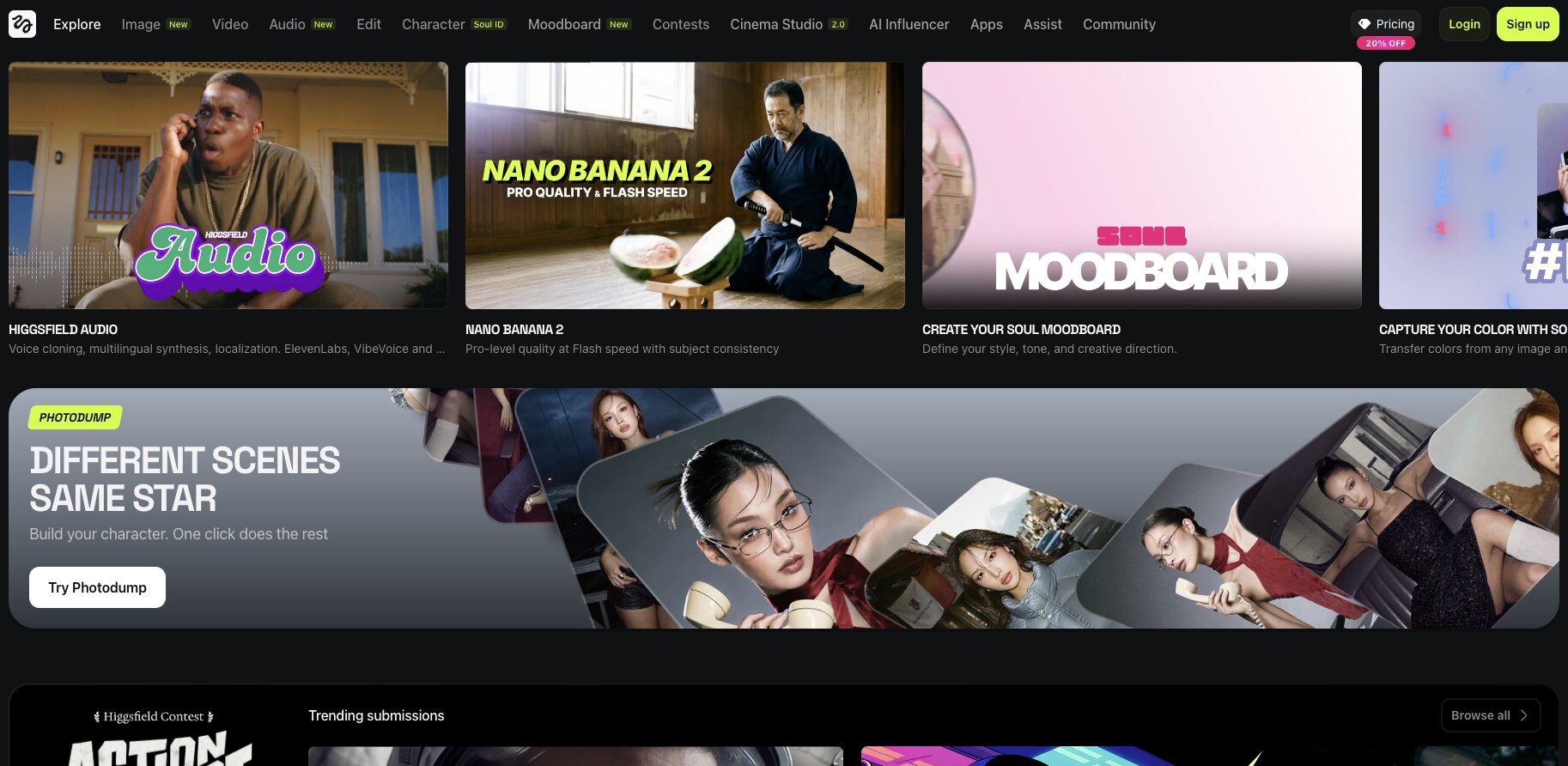
- Best for: All-in-one AI video creation and editing
- Pricing: Starts at $9/month
- How I use it: Connecting multiple AI video models, generating voiceovers, and editing videos all in one platform
Higgsfield is an all-in-one platform for creating videos with AI. You can think of it as the Cursor for AI videos or the Gumloop for AI videos, as the platform lets you connect multiple video models along with a bunch of video editing, image generation, and audio tools.
Higgsfield also has its own models like Higgsfield Audio for voice cloning and multilingual synthesis. You can also connect ElevenLabs into the platform. So you get a full integrated environment for anything related to video generation.
Higgsfield essentially brings all of those different models and tools into one place. Instead of jumping between five different AI video tools, you just do everything from one dashboard.
Here are some things I like about Higgsfield:
- Connects multiple AI video models in one platform
- Has its own audio and voice cloning models built in
- Supports image generation alongside video editing
- Credit-based pricing makes it affordable to start
Here are some cons with Higgsfield:
- No free plan available
- Still a newer platform so some features are evolving
- Can get expensive at higher tiers if you are creating a lot of content
Higgsfield pricing
Here are Higgsfield’s pricing plans:
- Basic: $9/month with 150 credits, access to selected models, and up to 2 concurrent videos
- Pro: $29/month with 600 credits, access to all models, and up to 3 concurrent videos
- Ultimate: $49/month with 1,200 credits, access to all models, and up to 4 concurrent videos
- Creator: $250/month with 6,000 credits, access to all models, up to 8 concurrent videos, and 35% cheaper cost per credit
All plans include access to all features, early access to advanced AI features, and discounts on extra credits.
Higgsfield reviews
Here is what users rate Higgsfield on third-party review sites:
- G2: 4.3/5 star rating (from +21 user reviews)
- Product Hunt: 4.7/5 star rating (from +3 user reviews)
6. Weavy
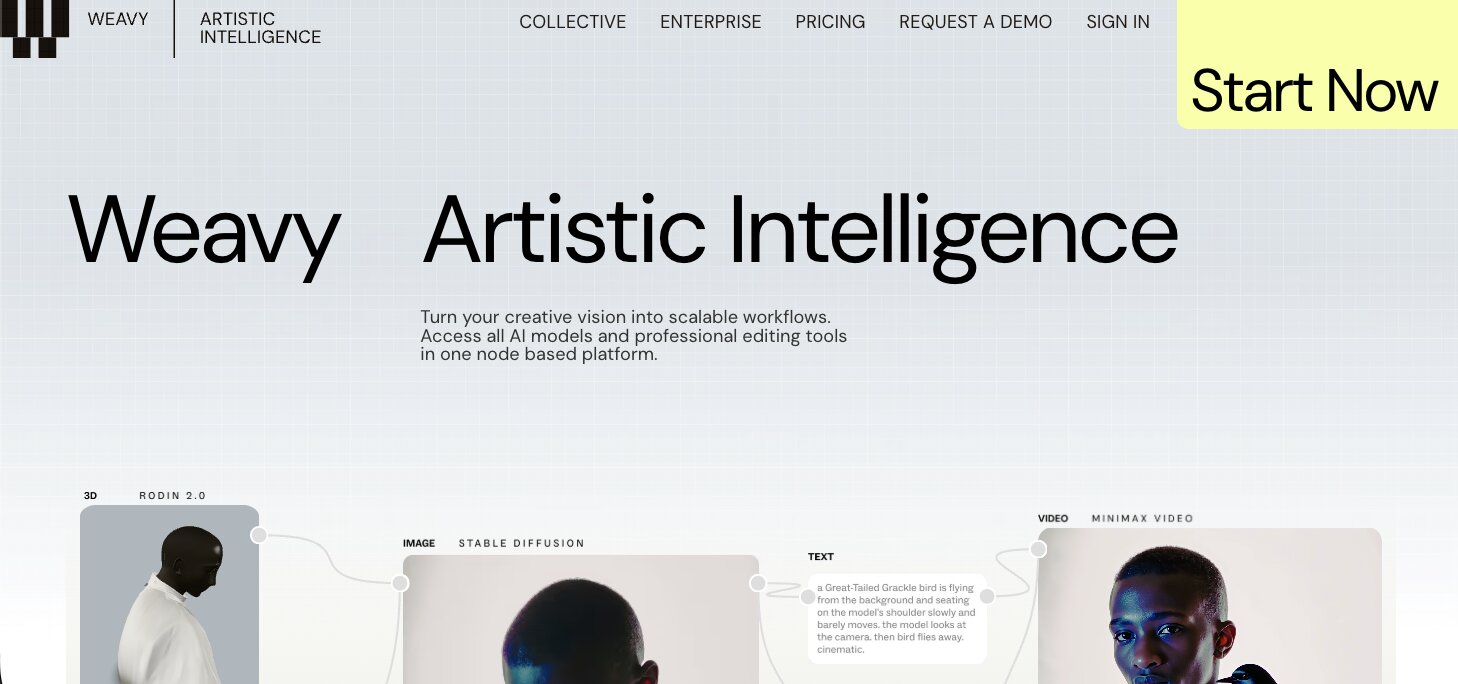
- Best for: AI image generation workflows and on-brand visual content
- Pricing: Free plan available, then starts at $24/month
- How I use it: Creating on-brand blog post thumbnails using custom workflows built around our design system
Weavy (now apart of Figma) is a platform for creating image generation workflows. You can think of it as Higgsfield, but specifically for images and short animations.
I have actually been using Weavy a lot recently for creating blog post images that are on brand. For example, if you actually scroll up and look at the thumbnail image for this blog post, it was created with the help of Weavy.
Essentially, I upload example designs from our designer into a workflow and set up prompt templates for the types of thumbnails I want. From there, I can quickly generate different thumbnails by tweaking the prompt slightly each time to customize it for that specific blog post.
Here are some things I like about Weavy:
- Workflow-based approach makes batch image creation fast
- Full access to all AI models even on the free plan
- Commercial license included on every plan
- Great for creating consistent, on-brand visuals
Here are some cons with Weavy:
- Free plan is limited to 150 credits and 5 workflows
- Credit system means heavy users will burn through allowances quickly
- Still a newer tool so the community is small
- Video generation eats through credits much faster than images
Weavy pricing
Here are Weavy’s pricing plans:
- Free: $0/month with 150 credits, full access to all AI models, professional editing tools, and 5 workflows
- Starter: $24/month with 1,500 credits, unlimited workflows, and top-ups at $10 for 1,000 credits
- Professional: $45/month with 4,000 credits, 3-month credit rollover, and top-ups at $10 for 1,200 credits
- Team: $60/user/month with 4,500 credits per user, shared credit pool, unified billing, and workspace file sharing
You can learn more about what each plan has to offer here.
7. ElevenLabs
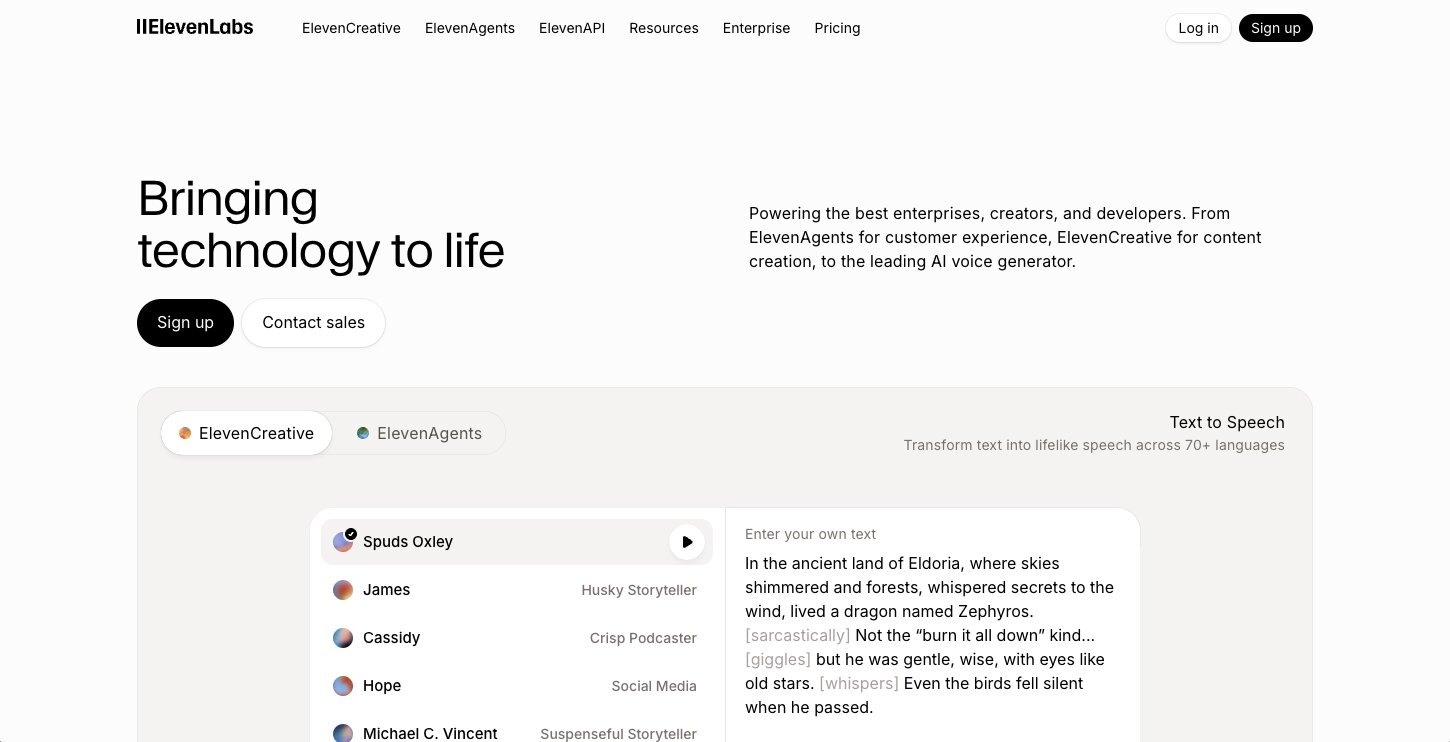
- Best for: AI voice generation, voiceovers, and conversational agents
- Pricing: Free plan available, then starts at $5/month
- How I use it: Generating voiceovers for AI videos and experimenting with conversational agents
ElevenLabs is the popular AI voice generation app. You can give it a transcript and it will generate a human-like voiceover. It can be used for a wide range of use cases like voiceovers for AI-generated videos, creating agents that can read content on your site to visitors, and a lot more.
They also now have ElevenLabs Agents, which is a feature to deploy and monitor conversational agents. So you can build this directly into your products and create ultra-realistic speech across 70 plus languages.
ElevenLabs continues to be the best platform for voiceovers and conversational agents. So if you are ever in a situation where you need AI to speak something out, ElevenLabs is definitely the app to use.
Here are some things I like about ElevenLabs:
- Voice quality is the most realistic on the market right now
- Supports 70+ languages for both voiceovers and agents
- Free plan is generous enough to test with
- ElevenLabs Agents lets you deploy conversational AI into your own products
Here are some cons with ElevenLabs:
- Can get pricey if you are generating a lot of audio content
- Voice cloning is only available on paid plans
- Agent plans are a separate add-on billed per usage
- Free plan is limited to 10k credits per month
ElevenLabs pricing
Here are ElevenLabs’ pricing plans:
- Free: $0/month with 10k credits, text to speech, speech to text, sound effects, voice design, music, and 3 projects
- Starter: $5/month with 30k credits, commercial license, instant voice cloning, and 20 projects
- Creator: $11/month (first month 50% off) with 100k credits, professional voice cloning, and 192kbps audio quality
- Pro: $99/month with everything in Creator plus 44.1kHz PCM audio output via API
Agent plans are a separate add-on and billed per usage. You can learn more about it here.
ElevenLabs reviews
Here is what users rate ElevenLabs on third-party review sites:
- G2: 4.5/5 star rating (from +1,139 user reviews)
- Product Hunt: 4.9/5 star rating (from +155 user reviews)
8. Paradigm AI
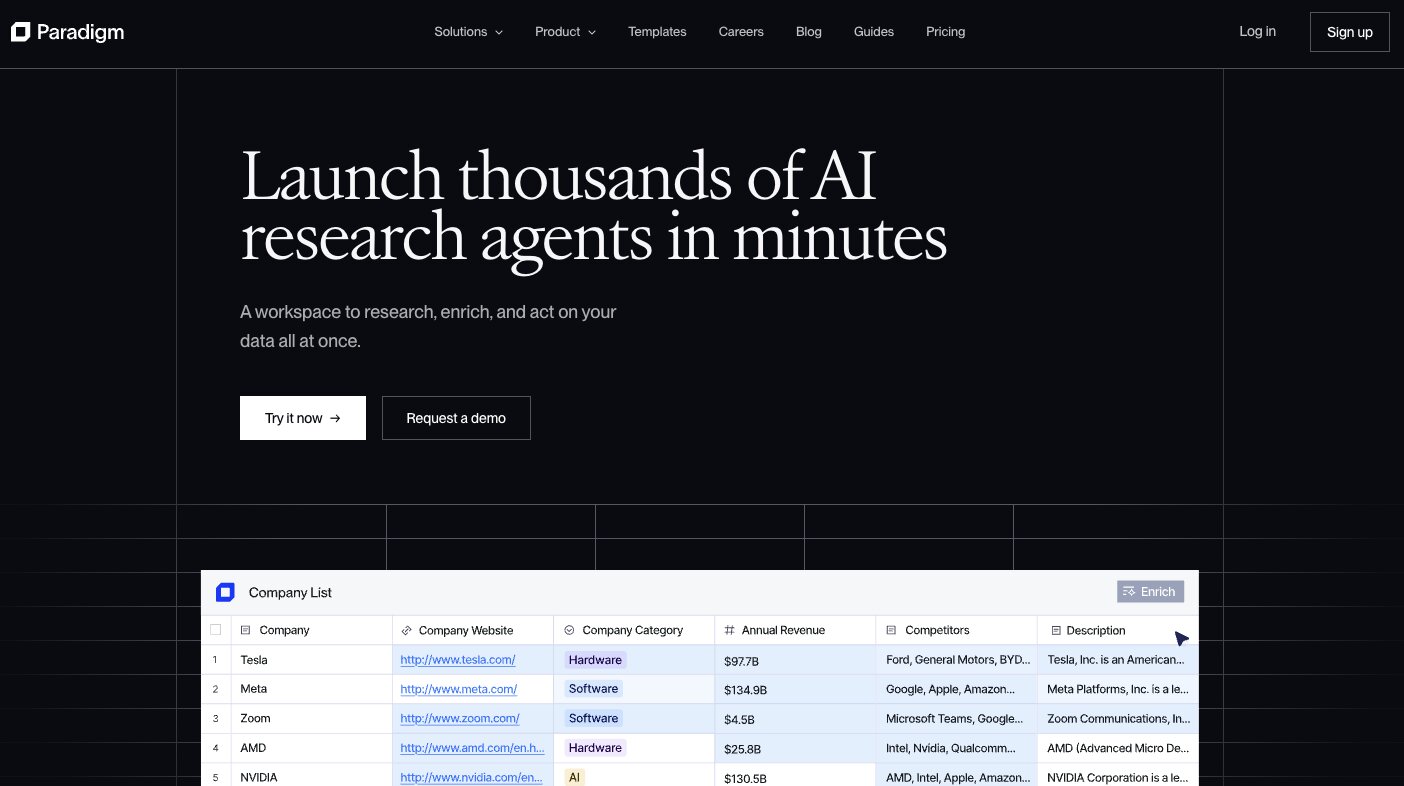
- Best for: Enriching spreadsheet data with AI agents
- Pricing: Free plan available, Pro starts at $20/month
- How I use it: Enriching keyword lists with search intent data and bulk research tasks across spreadsheet columns
Paradigm AI is like a spreadsheet meets AI agents platform. I have been using it quite a bit recently, and it has become one of my favorite tools for anytime I use a spreadsheet but also want to be able to leverage AI to do things within the spreadsheet. It feels like a Clay alternative, it is very similar to that tool, except it is more horizontal and can serve a broad range of use cases.
One thing that is interesting about Paradigm is that their product is based around this concept that every cell is an AI agent.
So I can create a list of keywords I want to go after in a column, and then I can have a prompt for another column that says what the search intent is, and I can enrich that data in one click. A bunch of AI agents will fire, searching every keyword and then reporting back in a new column what the search intent should be.
You can think of this for pretty much any use case and how it can apply to you. It basically can help you enrich a lot of data within spreadsheets.
Here are some things I like about Paradigm AI:
- Every cell acts as an AI agent, which is a unique approach
- Great for bulk data enrichment tasks like keyword research
- Similar to Clay but works across more use cases
- Supports CSV and XLSX imports so you can bring in existing data
Here are some cons with Paradigm AI:
- Free plan has a monthly cap and no on-demand usage
- Big jump from Pro ($20/month) to Business ($500/month)
- Premium AI models are only available on Business and above
- Still a newer tool so integrations are limited compared to Clay
Paradigm AI pricing
Here are Paradigm AI’s pricing plans:
- Starter: Free with daily usage up to a monthly cap, basic AI chat, basic AI models, and up to 100 emails per month
- Pro: $20/month with $20 of on-demand usage, up to 50 team seats, full email access, personal analytics, and webhooks
- Business: $500/month with $500 of on-demand usage, premium AI chat, premium AI models, team analytics, and Slack support
- Enterprise: Custom pricing with custom usage allocation, custom seat count, full RBAC, domain auto-verification, and SSO
You can see what each plan has to off on their pricing page.
Paradigm AI is still a new platform, so there aren’t many user ratings on third-party review sites.
9. Clearscope

- Best for: SEO content optimization and keyword research
- Pricing: Starts at $129/month
- How I use it: Running SEO reports on target keywords to identify what content and terms I need to include on a page to maximize its ranking potential
Clearscope is a classic AI tool that existed before most of the AI apps on this list did. I first discovered Clearscope back in 2019, and what the platform does is it uses AI to tell you what keywords you should include on a page for it to maximize its ranking potential.
You give Clearscope a keyword and it generates an SEO report on your competitors that target that same keyword. Then it tells you what content you should include on your webpage to maximize its reach.
I say it’s the “AI tool before AI really became a thing” because Clearscope has been using IBM Watson and Google NLP to run it’s AI for a long time.
Their tool can search a target keyword and then identify the frequency of related terms between all the top ranking pages. This can also be referred to as something like TF-IDF. And then it uses AI to figure out what the semantically related keywords are that you should include in your page.
Here are some things I like about Clearscope:
- Gives you a clear content grade so you know when your page is optimized
- Been around since before the AI boom so the product is mature and reliable
- Pulls keyword recommendations based on what is actually ranking
- Integrates with Google Docs and WordPress
Here are some cons with Clearscope:
- No free plan and the entry price of $129/month is steep
- Does not do full keyword research on its own
- Limited to content optimization, so you still need other SEO tools
- Can feel pricey compared to alternatives like Surfer SEO
Clearscope pricing
Here are Clearscope’s pricing plans:
- Essentials: $129/month with 20 AI tracked topics, 20 monthly topic explorations, 20 monthly AI drafts, and 50 content inventory pages
- Business: $399/month with 50 AI tracked topics, 50 monthly topic explorations, 20 monthly AI drafts, 300 content inventory pages, and a dedicated account manager
- Enterprise: Custom pricing with custom credits, custom agreements, crawler whitelisting, and SSO
You can view more details about each plan here.
Clearscope reviews
Here is what users rate Clearscope on third-party review sites:
- G2: 4.9/5 star rating (from +92 user reviews)
- Capterra: 4.9/5 star rating (from +60 user reviews)
10. v0
- Best for: Prototyping web apps and websites with great design
- Pricing: Free plan available, Premium starts at $20/month
- How I use it: Prototyping app designs and website layouts, then exporting the code into Cursor to build out into production
If you want to build prototypes of web apps or beautifully designed websites, then v0 is definitely a tool you need to check out. It is the best vibe coding tool I have found for prototyping apps and websites, especially if you care a lot about design.
The tool is created by the team at Vercel, the popular hosting platform. So you can actually host your websites and products on Vercel by using v0. The tool also integrates with Supabase, so you can create a full database for your apps in v0.
Although the way that I personally like to use it is to prototype with it and then export the code and import it into Cursor where I will continue to flesh out the prototype into a more production-ready tool. Nevertheless, v0 is a great AI app for prototyping and vibe coding. And I think it is the best option if you have not used any vibe coding tool yet.
Here are some things I like about v0:
- Best design quality of any vibe coding tool I have tried
- Built by Vercel so you can deploy directly from the platform
- Supabase integration lets you add a full database
- Free plan includes $5 of monthly credits and GitHub sync
Here are some cons with v0:
- Free plan is limited to 7 messages per day
- Output sometimes needs cleanup for production use
- Better for prototyping than building full production apps
- Credits can run out fast on complex projects
v0 pricing
Here are v0’s pricing plans:
- Free: $0/month with $5 of included credits, deploy to Vercel, visual design mode, and GitHub sync (7 message/day limit)
- Premium: $20/month with $20 of included credits, $2 of free daily credits on login, 5x higher attachment limits, and Figma import
- Team: $30/user/month with $30 of included credits per user, shared team credits, and centralized billing
- Business: $100/user/month with everything in Team plus training opt-out by default
- Enterprise: Custom pricing with SSO, RBAC, priority access, and guaranteed support
You can view more details about each plan here.
v0 reviews
Here is what users rate v0 on third-party review sites:
- Product Hunt: 4.8/5 star rating (from +52 user reviews)
- G2: 4.7/5 star rating (from +52 user reviews)
11. Lovable
- Best for: Building full-stack web apps and websites without writing code
- Pricing: Free plan available, Pro starts at $25/month
- How I use it: Quickly prototyping app ideas and internal tools by describing what I want in plain language
Staying on the theme of vibe coding, Lovable is an AI website builder that helps you create apps and websites in natural language. You describe what you want, it builds a working prototype in real time, and you can iterate on it with simple feedback and deploy it with one click.
It also connects to databases like Supabase and syncs with GitHub, so you can take your project further if needed (similar to the v0 to Cursor use case).
The difference between Lovable and v0 is that Lovable is more focused on building full working apps rather than just frontend prototypes. If v0 is where I go for design-first prototyping, Lovable is where I go when I want a working product fast without touching code. They also have a solid template library if you do not want to start from scratch.
Here are some things I like about Lovable:
- Can generate full working apps from prompts
- One-click deploy so you can ship fast
- Connects to databases and GitHub out of the box
- Unlimited collaborators even on the free plan
Here are some cons with Lovable:
- Free plan is limited to 5 daily credits and public projects only
- Designs can look like every other vibe coded app or website
- Not ideal for complex enterprise-level applications
- You still need some technical understanding to debug issues
Lovable pricing
Here are Lovable’s pricing plans:
- Free: $0/month with 5 daily credits (up to 30/month), public projects, unlimited collaborators, and 5 lovable.app domains
- Pro: $25/month with 100 monthly credits, 5 daily credits (up to 150/month), credit rollovers, custom domains, and user roles
- Business: $50/month with everything in Pro plus internal publish, SSO, team workspace, design templates, and security center
- Enterprise: Custom pricing with dedicated support, onboarding services, SCIM, audit logs, and publishing controls
You can learn more about Lovable’s pricing plans here.
Lovable reviews
Here is what users rate Lovable on third-party review sites:
- Product Hunt: 4.6/5 star rating (from +166 user reviews)
- G2: 4.6/5 star rating (from +208 user reviews)
12. Originality AI
- Best for: AI content detection and plagiarism checking
- Pricing: Pay as you go for $30, or Pro starts at $14.95/month
- How I use it: Scanning blog posts and content drafts to check for AI detection flags before publishing
Originality AI is the main tool I use for analyzing content for AI detection. Out of every AI content detector I have used, it has consistently been the most accurate and highest quality. It also includes a plagiarism checker, readability checker, and fact-checking aid all in the same platform.
However, it is important to note that these tools should be used as guides and not ultimate truths. I have had times where 100% human-written content has been flagged as generated by AI in this tool and others.
So take these with a grain of salt, but like I mentioned, this platform is the most accurate one I have seen.
Here are some things I like about Originality AI:
- Most accurate AI detection tool I have tested
- Includes plagiarism, readability, and fact-checking in one tool
- Pay-as-you-go option so you do not need a subscription
- Chrome extension and WordPress plugin for easy access
Here are some cons with Originality AI:
- No AI detection tool is 100% accurate, including this one
- Pay-as-you-go credits expire after 2 years
- Free plan does not exist, you have to pay to use it
- Interface is functional but not the most polished
Originality AI pricing
Here are Originality AI’s pricing plans:
- Pay as you go: $30 one-time payment with 3,000 credits, AI checker, plagiarism checker, readability checker, fact-checking aid, and 30 days scan history
- Pro: $14.95/month with 2,000 credits per month, file uploads, full site scans, team management, and Chrome extension
- Enterprise: $179/month with 15,000 credits per month, dedicated customer success manager, priority support, 365 days scan history, and API access
You can view more details about each plan here.
Originality AI reviews
Here is what users rate Originality AI on third-party review sites:
- G2: 4.5/5 star rating (from +171 user reviews)
- Capterra: 5/5 star rating (from +7 user reviews)
13. Descript
- Best for: AI-powered video and podcast editing
- Pricing: Free plan available, then starts at $16/month
- How I use it: Editing long-form video content, removing filler words, and generating scripts with AI
Descript is an AI editing platform designed for long-form videos and podcasts. It is great if you are working on video projects that require a script to be read on the video. With Descript you can edit and generate scripts with their AI. You can even create custom videos for B-roll sections.
The platform has evolved into a full text-based editing platform with AI tools that can handle things like green screen, eye contact correction, studio sound, and filler word removal. It is a full video, podcast, and clips editing platform with AI sprinkled on top.
Here are some things I like about Descript:
- Edit video by editing text, which is genuinely a game-changing workflow
- AI filler word removal saves hours of manual editing
- Studio Sound cleans up bad audio quality automatically
- Can generate scripts, video clips, and custom voice clones
Here are some cons with Descript:
- Free plan is very limited and mainly good for testing
- Can feel a bit slow with longer projects or large files
- AI credits run out fast if you are using a lot of AI tools
- 1080p export is limited to the Hobbyist plan, 4K requires Creator
Descript pricing
Here are Descript’s pricing plans:
- Free: $0/month to get started with text-based editing and basic AI tools
- Hobbyist: $16/month (or $24 monthly) with 10 media hours, 400 AI credits, 1080p export, and AI tools including Studio Sound and filler word removal
- Creator: $24/month (or $35 monthly) with 30 media hours, 800 AI credits, 4K export, full Underlord access, AI video generation, and stock media library
- Business: $50/month (or $65 monthly) with 40 media hours, 1,500 AI credits, Brand Studio, 30+ language dubbing, custom avatars, and priority support
- Enterprise: Custom pricing with SSO/SCIM, granular brand controls, custom AI credits, and flexible licensing
You can view more details about each plan here.
Descript reviews
Here is what users rate Descript on third-party review sites:
- G2: 4.6/5 star rating (from +854 user reviews)
- Capterra: 4.7/5 star rating (from +179 user reviews)
14. Perplexity
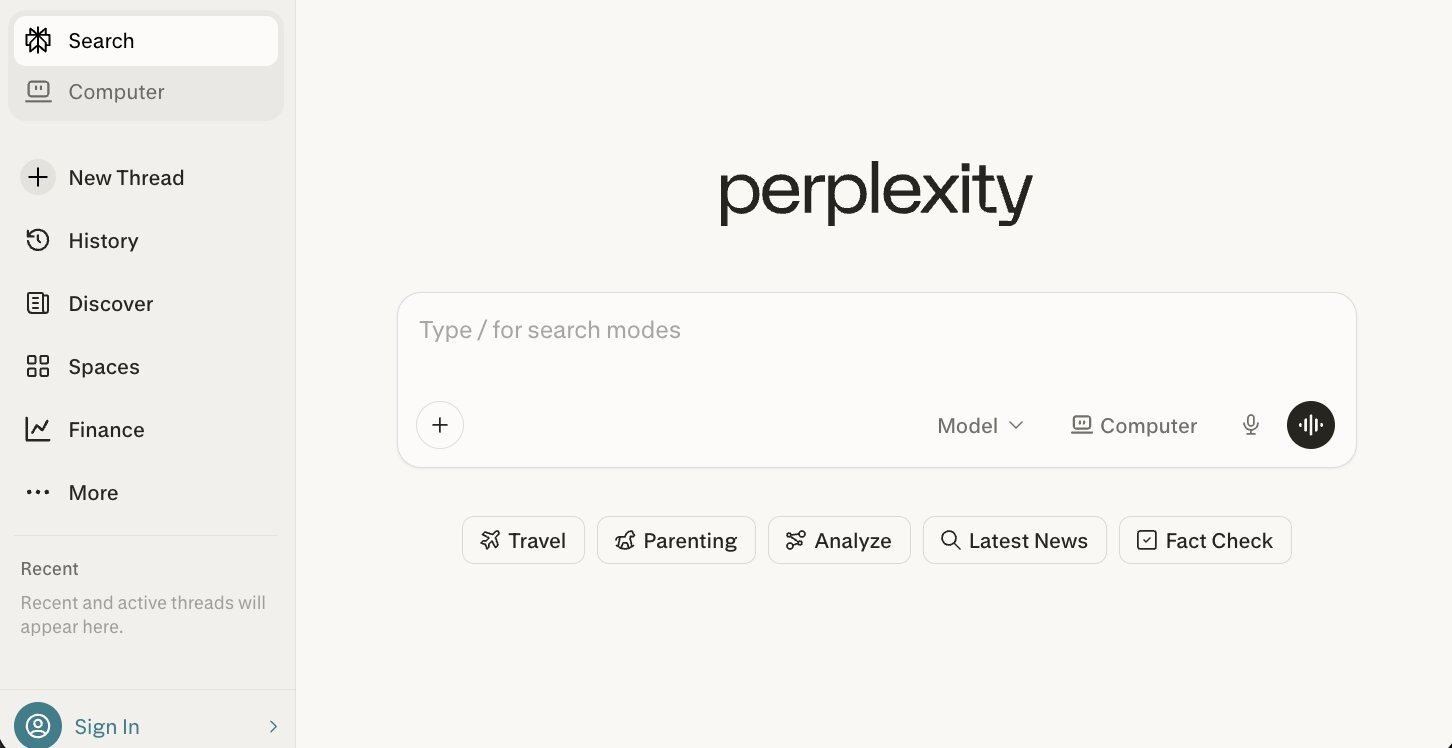
- Best for: AI-powered research and conversational web search
- Pricing: Free plan available, Pro starts at $17/month (billed annually)
- How I use it: Researching statistics, content ideas, and trends with deep web search and sourced answers
Perplexity is an AI search engine that has quickly become my favorite way to research any topic. The cool thing about Perplexity is that it can do a social search and pull in insights from forums and UGC content.
You can also use Perplexity like you would ChatGPT or Claude, except it has a lot better web searching capabilities compared to those platforms. So it is best used when you have prompts that need web searches or deep research. Whether you are searching for statistics, content ideas, trends, or literally anything and want a conversational search experience, Perplexity is definitely an app to check out.
They also now have a Computer feature that is an AI agent that can complete tasks for you. It is very similar to how Claude Cowork or ChatGPT Agent works.
Here are some things I like about Perplexity:
- Gives you sourced, cited answers instead of just a list of links
- Social search pulls insights from forums and UGC content
- Pro plan lets you choose between GPT-5.2, Gemini 3.1 Pro, Grok 4.1, and more
- Computer feature lets you delegate tasks to an AI agent
Here are some cons with Perplexity:
- Sources are not always the most authoritative
- Can sometimes confidently present outdated information
- Free plan has limited access to advanced models
- Ultra plan at $167/month is expensive for most users
Perplexity pricing
Here are Perplexity’s pricing plans:
- Free: $0/month with basic search and AI answers
- Pro: $17/month (billed annually) with access to GPT-5.2, Gemini 3.1 Pro, Grok 4.1, deeper sourcing from proprietary data, and reports/documents/apps
- Ultra: $167/month (billed annually) with advanced reasoning models, deep investigations at scale, massive dataset support, 45,000 monthly Computer credits, and Model Council
You can view all the plans here.
Perplexity reviews
Here is what users rate Perplexity on third-party review sites:
- G2: 4.5/5 star rating (from +238 user reviews)
- Capterra: 4.6/5 star rating (from +30 user reviews)
15. Gamma
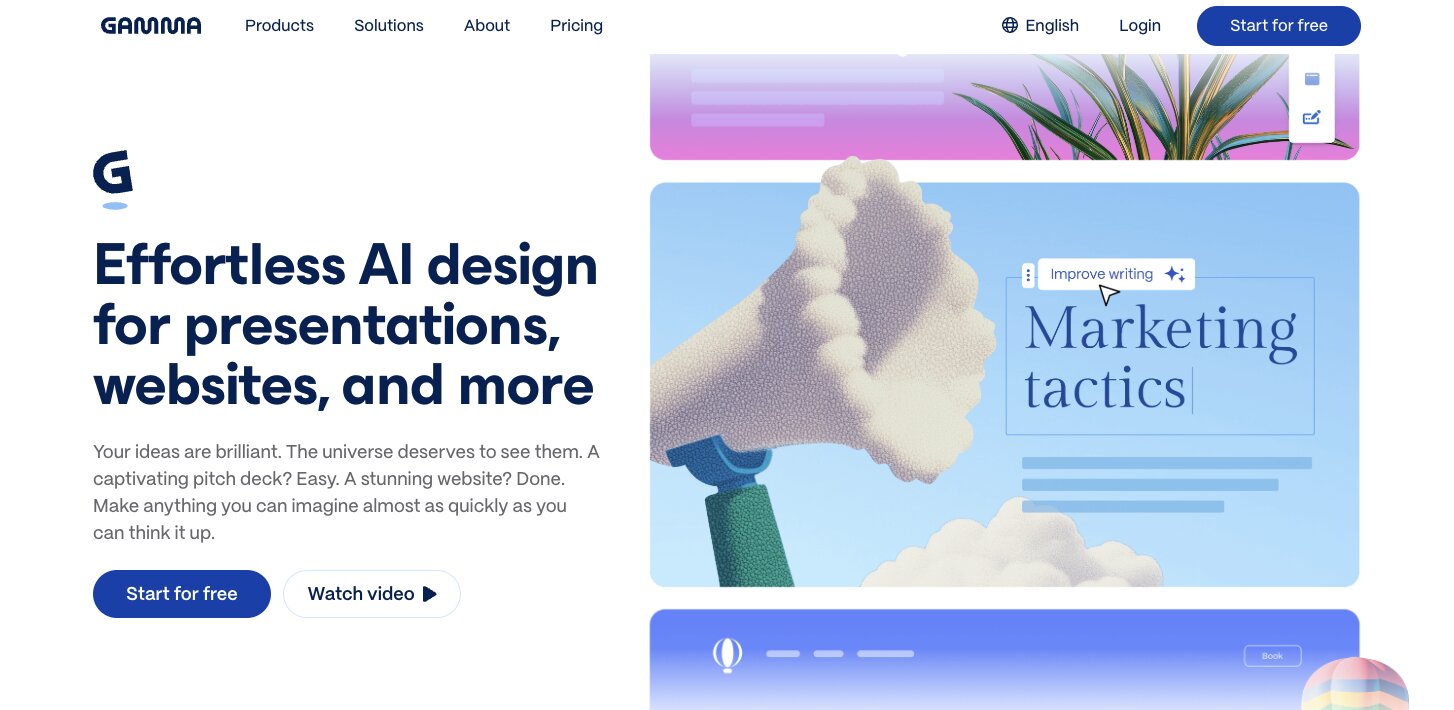
- Best for: AI-powered presentations, documents, and pitch decks
- Pricing: Free plan available, Plus starts at $12/month
- How I use it: Creating pitch decks, proposal documents, and social media visuals without needing a designer
Gamma is an AI presentation builder that makes it easy to create great looking pitch decks. You can also use Gamma for things like social media posts, creating websites, and creating documents for proposals, PDFs, or literally anything. It is a full platform for creating presentations and documents with a bunch of generative AI tools. You can think of it like the Canva for documents and slides.
Here are some things I like about Gamma:
- Generates full presentations from a text prompt in seconds
- Supports presentations, docs, websites, social posts, and images all in one tool
- Import from PDF and PPTX so you can work with existing files
- Export to PDF, PPTX, PNG, and Google Slides
Here are some cons with Gamma:
- Free plan is limited to 400 credits at signup with no monthly refresh
- AI-generated content still needs editing to match your voice
- Limited customization compared to Figma or PowerPoint for detailed design
- Advanced AI models are locked behind Pro and Ultra plans
Gamma pricing
Here are Gamma’s pricing plans:
- Free: $0/month with 400 credits at signup, up to 10 cards per prompt, and export to PDF, PPTX, PNG, and Google Slides
- Plus: $12/seat/month with 1,000 monthly credits, up to 20 cards per prompt, Gamma branding removed, and advanced AI image models
- Pro: $25/seat/month with 4,000 monthly credits, up to 60 cards per prompt, custom branding and fonts, detailed analytics, API access, and workspace templates
- Ultra: $100/seat/month with 20,000 monthly credits, up to 75 cards per prompt, access to the most advanced AI models, and early access to new features
You can view all the plans here.
Gamma reviews
Here is what users rate Gamma on third-party review sites:
- G2: 4.1/5 star rating (from +22 user reviews)
- Product Hunt: 4.5/5 star rating (from +77 user reviews)
What is the best free AI?
If you are looking for the best free AI, it really depends on what you need it for. But if I had to pick one, I would say Claude. The free plan gives you access to web search, memory, file creation, MCP connectors, and even Slack and Google Workspace integrations. For a free AI chatbot, that is hard to beat.
But if you want free AI tools beyond just chat, Google Labs is the clear winner. Everything on the platform is free, and you get access to tools for image generation, email productivity, prototyping, and even a full AI-powered IDE with Antigravity. It is an entire ecosystem of free AI apps in one place.
And if you want to automate workflows with AI for free, Gumloop has a generous free plan that lets you build flows with 2,000 credits, unlimited nodes, and connect to any LLM model. That is enough to build a few automations and see how it fits into your workflow before committing to a paid plan.
At the end of the day, the best AI tools are the ones you actually keep using after the first week. I have tested over 70 of them and most I never opened again. These 15 are the ones that save me real time, they help me ship things faster, and a lot of them work automatically in the background while I focus on other things.
And honestly, we are still early. If the last three years taught me anything, it’s that the next wave of AI apps is probably going to look different than what we currently have.
AI platforms have evolved into robust systems that can automate workflows, analyze data, generate content, and even talk to your customers.
But with so many different AI platforms on the market — from general-purpose assistants like ChatGPT and Claude to specialized tools like Jasper or Make — choosing the right AI platform for your business can quickly become overwhelming.
Here’s what we’ll cover in this guide:
- 18 best AI platforms and what they do best
- How do they compare on pricing, usability, and flexibility
- Pros and cons of each tool
- Where tools like Lindy stand out
- Which platforms are ideal for individuals, startups, or enterprise teams
Let’s start with a quick look at how AI platforms differ from standalone tools.
What is an AI platform?
An AI platform is a software product that gives you access to multiple AI capabilities in one place — things like generating content, automating tasks, analyzing data, chatting with customers, or even taking voice calls.
The difference between an AI platform and a standalone tool is flexibility. Tools are often built for narrow, single-use cases. Platforms, on the other hand, allow you to customize inputs, chain together outputs, and integrate them into your team’s existing stack — Slack, Salesforce, Gmail, Notion, or Stripe.
Use cases vary widely depending on the platform. A solo founder might use an AI platform to write sales emails, follow up with leads, and auto-tag customer questions. A mid-size marketing team might use one to generate content at scale, translate it, and update their CMS.
Larger organizations might use AI to route tickets, analyze support data, or enrich millions of CRM records on autopilot. AI platforms let you move faster, remove manual grunt work, and shift your focus toward higher-leverage thinking.
To compile this list, I considered platforms that cater to different categories. Let’s explore them next.
AI platform categories we considered
We focused on platforms that solve problems across work, teams, and scale. Here are the key categories we looked at:
Content generation
These platforms help you write, design, or produce media — everything from blog posts and marketing copy to AI videos and voiceovers.
Examples: Jasper, Copy.ai, Notion AI, Synthesia, PlayAI.
Coding assistants
These tools are designed for developers or technical teams and help write, debug, and explain code. Some can even work across entire projects.
Examples: Cursor, Codex by ChatGPT, GitHub Copilot.
Customer support & chatbots
These platforms handle customer inquiries using AI, either through chat or voice. They learn from the knowledge base you provide and can often escalate to human agents when needed.
Examples: Intercom, Lindy, Vapi.
Automation & integrations
The goal is to connect your tools and automate business processes or internal workflows like lead routing or follow-ups triggered by user actions.
Examples: Zapier, Make, Lindy.
Analytics & decision-making
These platforms help make sense of data. Whether you’re forecasting churn or identifying why revenue dipped, these tools analyze and explain what’s going on.
Examples: Obviously AI, Tellius.
Voice & image processing
Some platforms specialize in audio and visual tasks — like generating realistic voiceovers, editing podcasts, or creating AI art.
Examples: Descript, PlayAI, Midjourney.
Multimodal & generalist AI
These are the all-rounders. They can write, code, analyze files, browse the web, and more — all within one assistant. They usually support text, image, voice, and file inputs.
Examples: ChatGPT, Claude, Perplexity.
Enterprise-scale AI frameworks
These are built for larger companies with technical teams and large data needs. They offer customizable models, API access, and integrations with cloud platforms.
Examples: Azure AI, Google Vertex, Amazon Bedrock.
With the categories out of the way, let’s focus on the AI platforms.
The 18 best AI platforms in 2025
I explored and tested 30+ AI platforms for their capabilities, features, and what they do exceptionally well. I found these 18 tools to be most valuable:
- Lindy –– best for automating complex workflows with custom AI agents
- Perplexity –– best for real-time research and fact-checked answers
- Jasper –– best for consistent branding and marketing content at scale
- Copy.ai –– best for fast marketing copy and product messaging
- Notion AI –– best for writing, summarizing, and organizing inside your workspace
- Grammarly –– best for real-time writing feedback and tone correction
- ChatGPT –– best for all-purpose brainstorming, writing, and logic-based tasks
- Claude –– best for thoughtful writing, document reasoning, and context-heavy tasks
- Cursor –– best for coding inside an AI-native IDE
- Synthesia –– best for turning scripts into polished videos with AI avatars
- PlayAI –– best for creating lifelike AI voiceovers in multiple languages
- Descript –– best for editing audio and video by editing text
- Midjourney –– best for generating high-quality, stylized AI visuals
- Vapi AI –– best for building real-time AI voice agents for phone calls
- Obviously AI –– best for running no-code predictions on business data
- Make –– best for building visual, multi-step automations across tools
- Intercom –– best for AI-powered customer support and live chat
- Zapier –– best for connecting apps and automating repeatable workflows
Let’s understand each of these tools in detail and see what tests I ran with them.
1. Lindy – best for automating complex workflows with custom AI agents
If you want to go beyond simple AI chatbots and offload work, Lindy is where I’d start. It’s an AI automation platform where you can build custom AI agents, called Lindies.
These agents can handle everything from sending emails and following up with leads to making phone calls, logging CRM data, or managing internal operations like summarizing meetings or sorting inbox attachments.
Lindy is incredibly easy to use. You can set up complex automation, trigger actions across apps like Slack, Gmail, HubSpot, Salesforce, and more, and create conditional workflows that behave differently based on context.
The best part about it is that you don’t need to write code. It’s a visual builder that lets you use customizable prebuilt templates like Email Follow-up Drafter or Meeting Scheduler. You can tweak the prompts in these templates, edit them to suit your application, and deploy them immediately.
I used a prebuilt Lead Generator template with filters like title and industry. Once connected to a source like People Data Labs, I prompted the Lindy chat to find me Content Strategist, Content Lead, Head of Content, or people in similar posts working in-house in software, SaaS, IT services, and product companies.
It searched for the leads that met my criteria and created a Google Sheet with detailed information about those leads. It took me less than 20 minutes to create a 10-person lead list. It easily replaced hours of weekly lead generation grunt work.
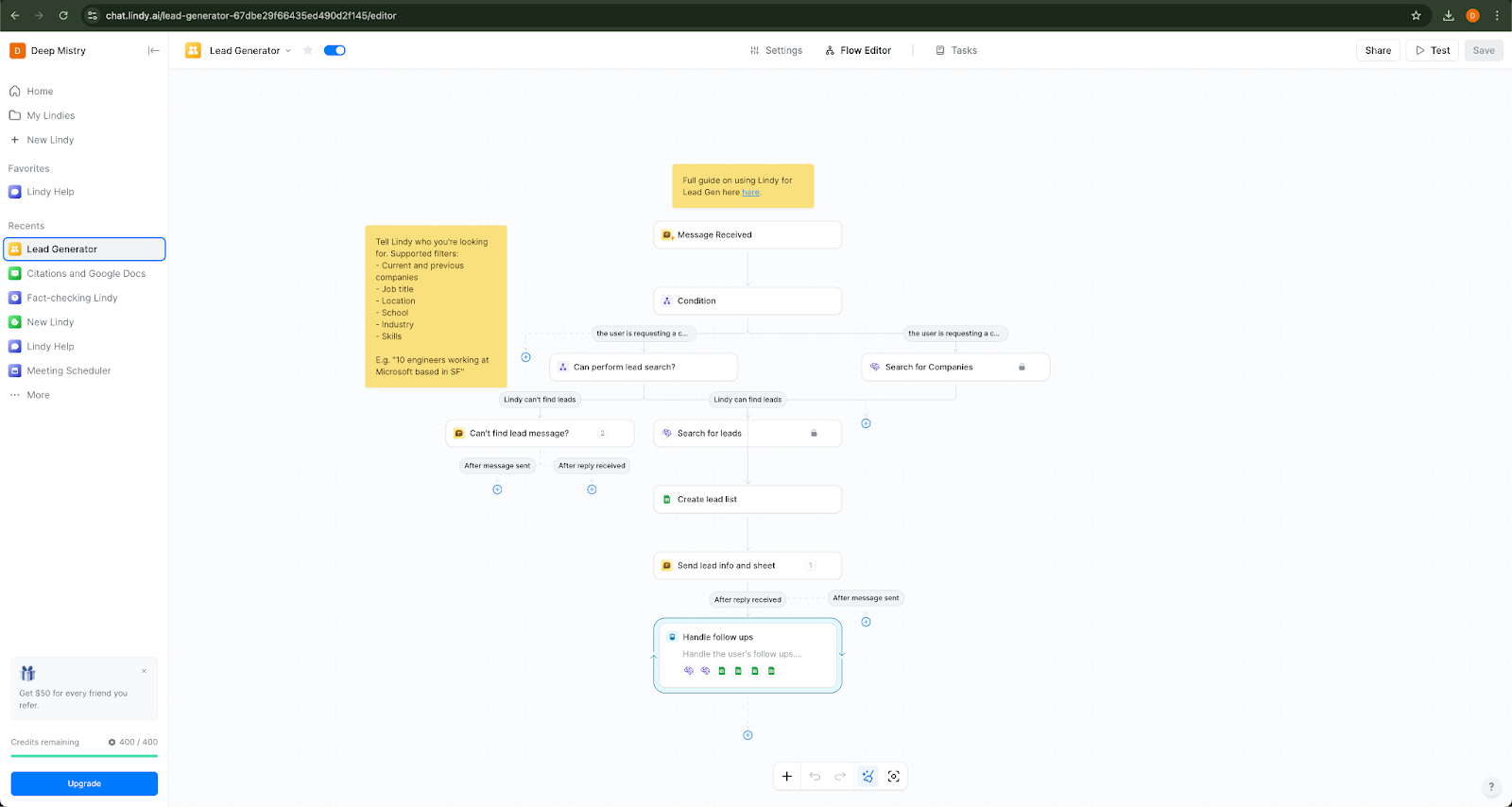
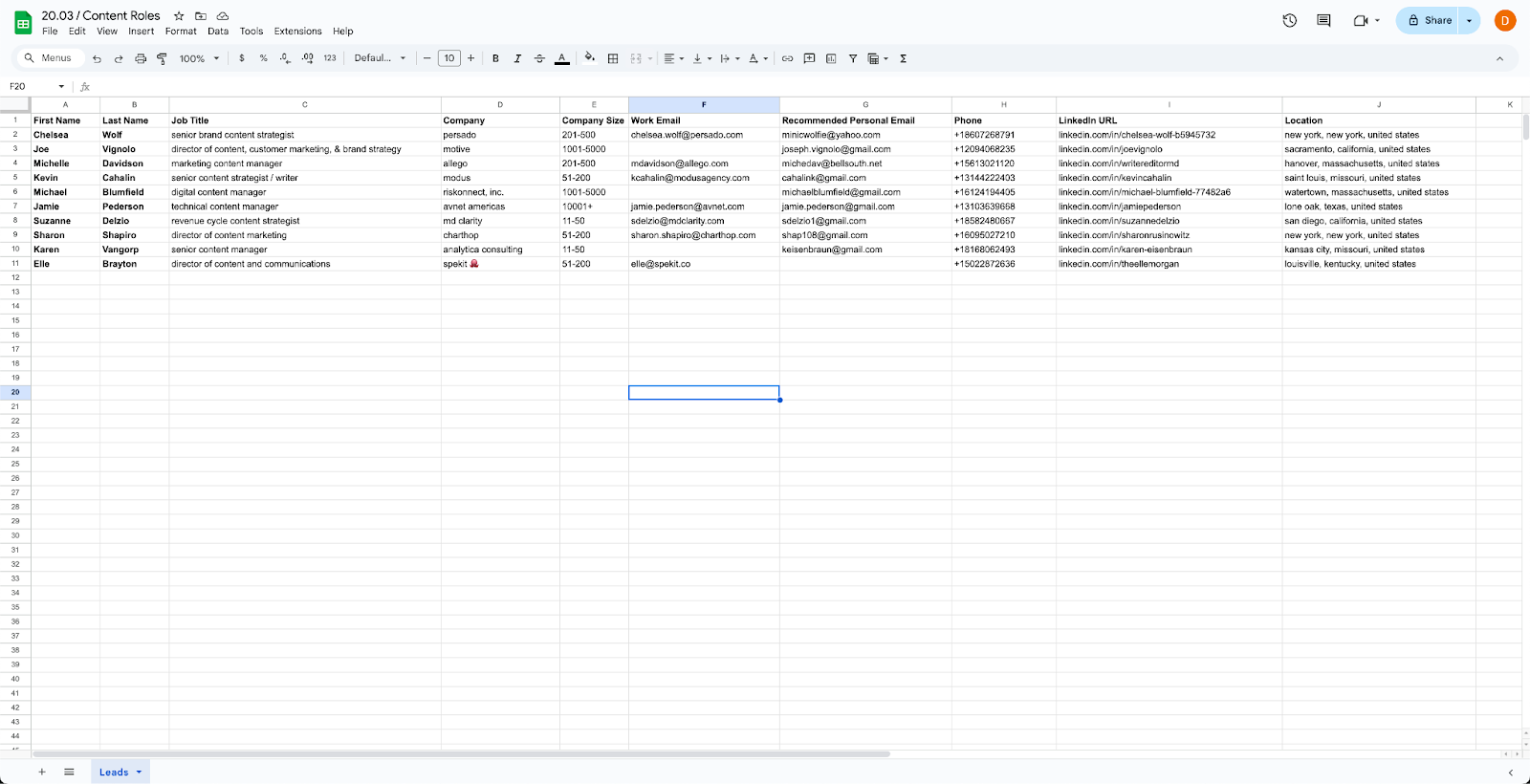
If your team spends time on repeatable processes like sales ops, customer support, or internal handoffs, this tool provides the most value.
Key features
- No-code builder for multi-step automations
- Voice agents for inbound/outbound calling
- Email, CRM, calendar, file, and Slack integrations
- Custom conditions, loops, and handoffs between Lindies
- 2500+ integrations via Pipedream partnership + API support
Pros
- Logic and control without dev work
- Agents feel personalized and task-specific
- Pricing is transparent and scales by usage
Cons
- There is a slight learning curve if you’re used to simple chatbots
Pricing
- Free plan: 400 credits/month
- Pro plan: $49.99/month, 5,000 credits
- Business and Enterprise tiers with advanced features and priority support
- Voice calling starts at $0.19/min for GPT-4o agents





2. Perplexity – best for real-time research and fact-checked answers
Perplexity is a smart, AI search assistant that answers questions, shows its sources, and keeps things concise. It is like a research partner who shows you the right links, explains them in plain English, and doesn’t waste your time.
I’ve used it for things like sourcing up-to-date stats, comparing product features, and checking the latest news on AI regulation. You can technically do all these tasks using Google, but it’s faster and more digestible here. It pulls from credible sources, cites everything in line, and lets you dig deep with the source links.
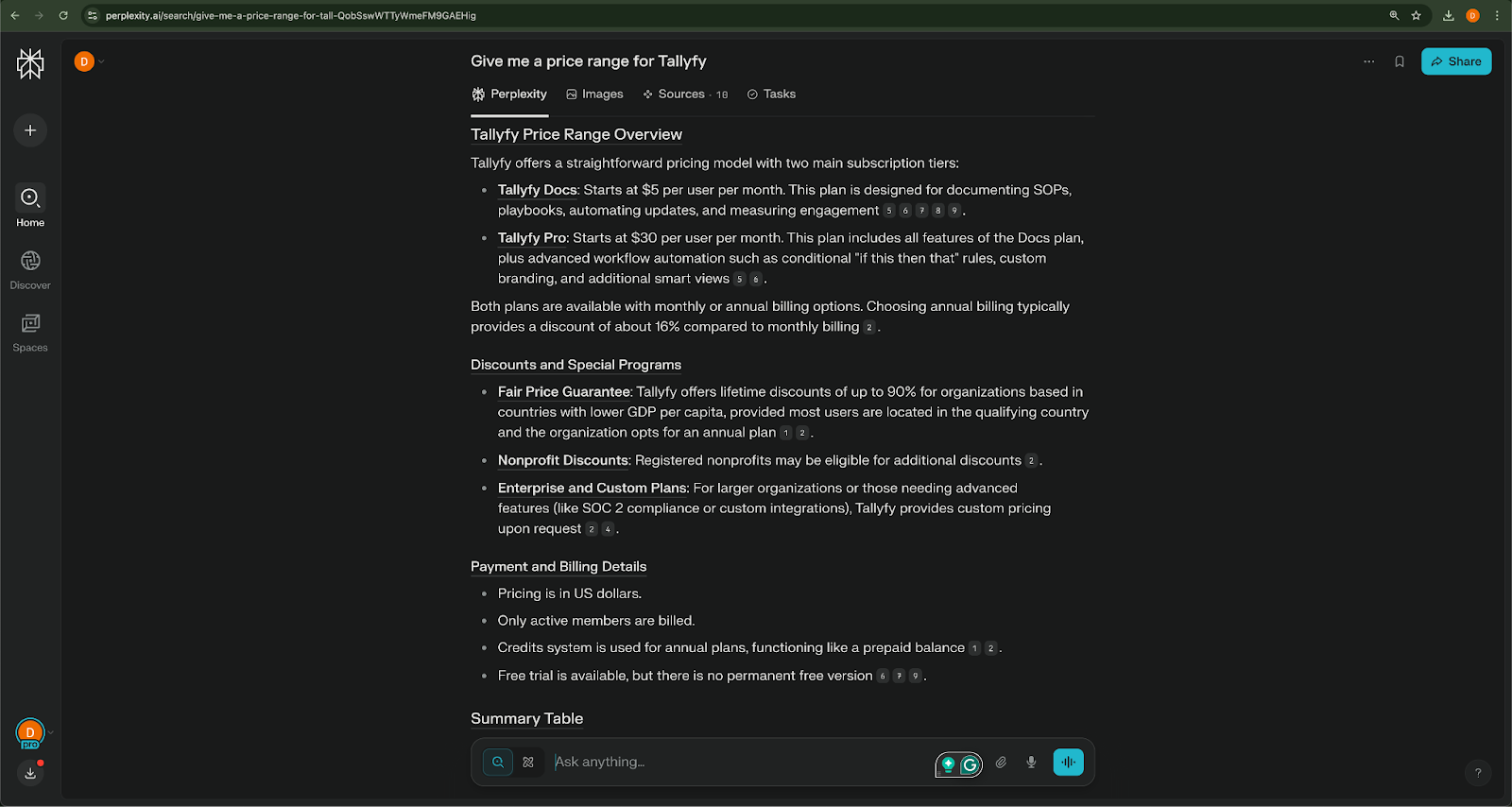
Perplexity’s Deep Research is a brilliant tool to help you research a topic in depth. It takes around 10-15 minutes to give you the complete results, but it’s totally worth it.
What’s underrated about Perplexity is how good it is at follow-up. You can ask something like, “How does Claude compare to GPT-4o?” and then follow up with, “What about for coding?” — it’ll keep the thread going intelligently.
It’s not a “do-anything” tool like ChatGPT or Claude, but it’s one of the most efficient tools I’ve used for research and reading-heavy workflows.
Key features
- Real-time web results with in-line citations
- Follow-up Q&A with persistent context
- File and image upload for context-aware queries
- iOS, Android, and browser extensions available
Pros
- Fast, reliable info without hallucinations
- Perfect for research, sourcing, and quick comparisons
- Includes free daily access to Pro models
Cons
- Not for tasks like writing or automation
- Some answers can still oversimplify nuanced topics
- Fewer customization options than larger assistants
Pricing
- Free plan: 3 Pro model queries per day
- Pro plan: $20/month
- Enterprise: $40/month per seat with admin tools and API access
3. Jasper – best for consistent branding and marketing content at scale
Jasper is an AI software built for marketers. It’s not just about generating content fast — Jasper is about staying on-brand, keeping the voice consistent, and scaling creative output.
What stood out to me most was its Brand Voice feature. You feed Jasper examples of your tone and messaging — emails, blog posts, social copy — and it learns how to match that across different formats.
I asked Jasper to write a blog after setting all the parameters –– brand voice, topic, outline, and resources. It took a while and generated a decent response that needed minimum edits.
The interface is clean, it has prebuilt workflows –– blog outlines, email campaigns, product descriptions, SEO content, and so on. You can also collaborate with teammates in real-time and leave feedback.
It makes sense if you’re running campaigns, managing a content pipeline, or juggling multiple client voices. However, it’s not cheap and won’t replace strategic thinking. It’s a production tool, not a strategy engine.
Key features
- AI trained on your brand voice
- Campaign workflows for blog, social, email, ads
- Team collaboration with version control and comments
- Built-in plagiarism checker and SEO mode
- API and CMS integrations
Pros
- Great for scaling consistent content across channels
- Workflow templates save time on repetitive tasks
- Reliable output quality when Brand Voice is dialed in
Cons
- You still need to guide it — it won’t know your strategy
- Pricey for small teams or casual users
- Can feel rigid outside marketing use cases
Pricing
- Creator (1 seat): $49/month
- Pro (teams): $69/seat/month
- Business: Custom pricing with advanced controls, SSO, analytics
4. Copy.ai – best for fast marketing copy and product messaging
Copy.ai uses AI to help you write something punchy — like a product description, ad variant, or value prop test and create AI workflows mostly around content and marketing. It’s a marketing sidekick that helps you go from idea to publishable copy in a few clicks.
The new Workflows feature helps you string together prompts like “summarize this”, “turn it into a headline”, “write a follow-up email,” and then run them on your entire lead list or campaign batch.
For example, I created a two-step sequence that took the content brief from me and turned it into mega blogs, with 15-20 sections in it. It took around 10 minutes for it to generate the entire blog but saved me hours.
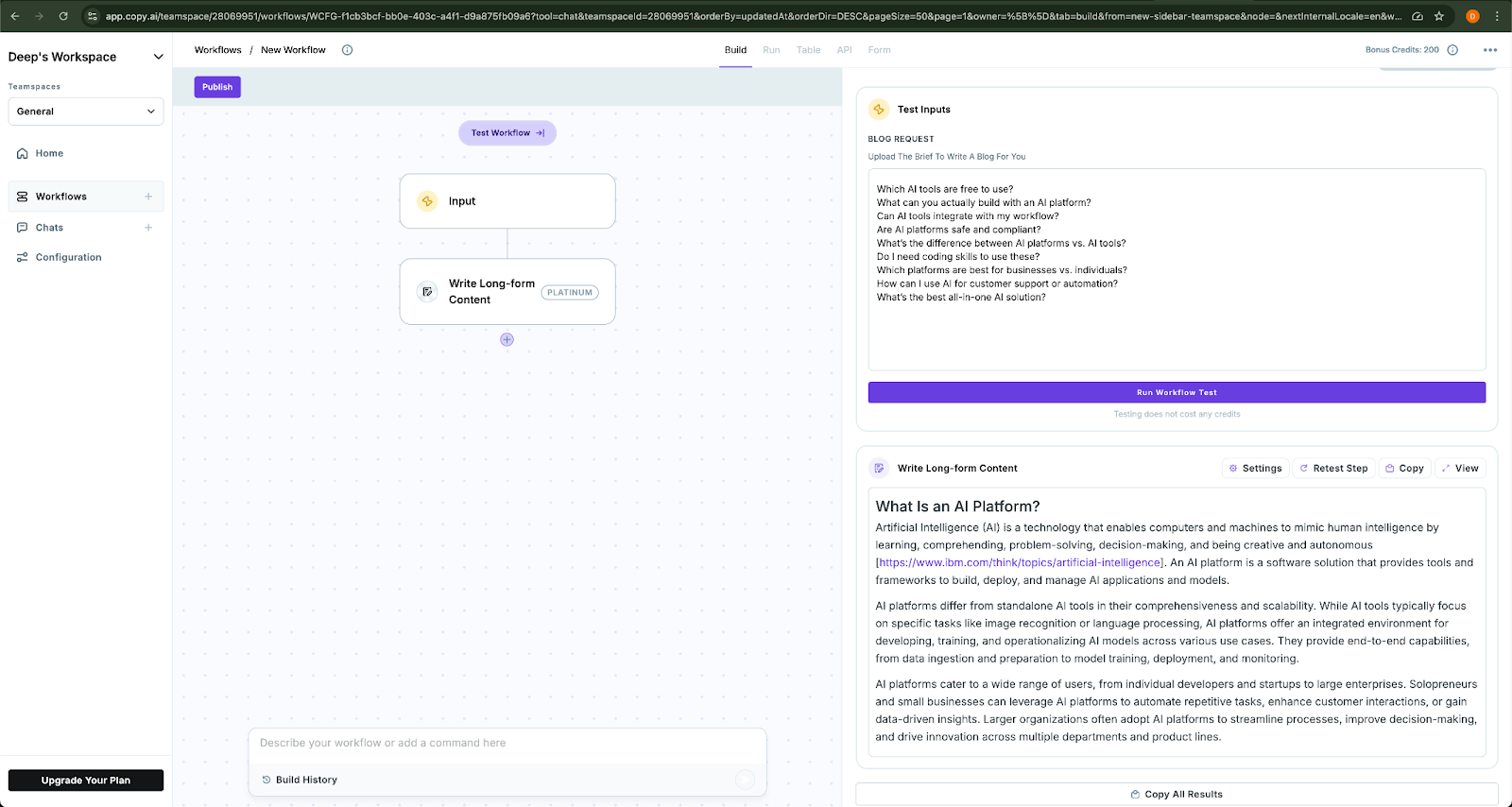
It also comes with hundreds of prebuilt and editable templates — LinkedIn posts, A/B test copy, product launches, and landing page sections. The tone sliders like bold, witty, or persuasive, are surprisingly good for dialing in the right feel without needing a brand brief.
It’s best suited for marketing, sales, and growth teams that need volume and variety without worrying too much about long-form content or heavy editing.
Key features
- AI workflows for batch content generation
- Pre-built templates for 100+ content types
- CSV import for bulk personalization
- Collaboration tools and saved copy history
- Zapier and HubSpot integrations
Pros
- Fast to use and easy to train new teammates on
- Great for short-form and high-variation messaging
- Workflows are powerful for scaling outbound and lead-gen
Cons
- Long-form blog content isn’t its strength
- UI can get cluttered with too many templates
- You’ll still need to check the tone and accuracy
Pricing
- Free plan: Up to 2,000 words/month
- Starter plan: $49/month, unlimited words, 1 seat
- Advanced: $249/month, up to 5 seats
5. Notion AI – best for writing, summarizing, and organizing inside your workspace
Notion AI is the most invisible AI baked into Notion for docs, wikis, or project planning. The AI layer quietly makes things easier. You’re not switching tools, not pasting between tabs. It helps you think faster, draft cleaner, or organize a mess.
I’ve used it to summarize meeting notes, clean up brainstorming notes, and draft first-draft outlines for internal docs. It’s fast and context-aware. You highlight some text, hit “summarize” or “improve writing,” and it tightens things up without losing your tone.
It’s also great for structuring chaotic information. I had a document full of scattered research notes. I asked Notion AI to create action items and tag key takeaways, giving me a clean list from which I could work. Stuff like that saves time.
However, Notion isn’t a complete content tool. It won’t replace your blog writing stack. It shines when you’re already in Notion and need a little push to move faster or think clearly.
Key features
- In-line AI writing, editing, and summarization
- Task list generation and action item extraction
- Q&A on existing Notion docs and databases
- Brainstorming tools for quick idea dumps
- Works across notes, wikis, databases, and calendars
Pros
- Seamless if you already live in Notion
- Great for cleaning up messy docs and notes
- It makes internal communication and planning faster
Cons
- Not suited for long-form content creation
- Lacks formatting controls during AI output
- Can get repetitive if overused on the same doc
Pricing
- Limited Notion AI trial on Free and Plus plans
- Notion Business/Enterprise plans have it baked in, with prices starting from $24/user/month
6. Grammarly – best for real-time writing feedback and tone correction
Grammarly quietly makes sure your writing doesn’t suck. Whether it’s a Slack message, a sales email, or a LinkedIn post, it catches the stuff that you miss while writing –– awkward phrasing, accidental typing errors, and weird tone shifts.
Grammarly can now tell you if your message sounds too blunt, overly formal, or unclear. Thanks to those nudges, I’ve caught myself softening cold emails or tightening up my blogs. It’s also good at catching passive voice and vague language, which creeps into copy more than most people realize.

They’ve added generative features too — you can rephrase, shorten, or expand sentences. But I don’t use it as a writing tool like I’d use Jasper or ChatGPT. Since the AI text generator isn’t as good as Claude or ChatGPT, I treat it like my proofreader and editing assistant.
It’s also cross-platform, so it works inside Google Docs, Gmail, Slack, and Notion — wherever you type. It invisibly works in the background, and that makes it so effective and unobtrusive.
Key features
- Real-time grammar, spelling, and punctuation checks
- Tone detection and rewrite suggestions
- Rephrasing, summarizing, and shortening tools
- Works across desktop apps, browsers, and mobile
- Weekly performance reports and writing insights
Pros
- Polishes your writing without changing your voice
- Great for teams that send a lot of external communication
- Highly valuable for content teams
Cons
- Not a complete content creation tool, more of a refinement layer
- Suggestions can feel repetitive for advanced writers
- Paid tiers can be expensive if you’re only using the basics
Pricing
- Free plan: Basic grammar and spelling
- Pro: $30/month, billed monthly
- Enterprise: Custom pricing
7. ChatGPT – best for all-purpose brainstorming, writing, and logic-based tasks
ChatGPT is a generalist AI platform. With GPT-4o, it’s finally fast, intelligent, and intuitive enough to act like a co-pilot for actual work, whether drafting copy, debugging code, helping with outlines, or parsing a spreadsheet.
It helps me think about a topic like a second brain. I’ve used it to summarize long meeting notes, draft cold emails, and even role-play customer objections for sales training. GPT-4o can now understand images, charts, and voice inputs, making it smarter than older versions.
I even created my custom GPT –– my ghost-writer. I uploaded all the resources, guidelines, and references to dial in my writing style. Now, I use it to create first drafts of my blogs. I also created a project to fact-check the technical capabilities of Lindy in blogs.
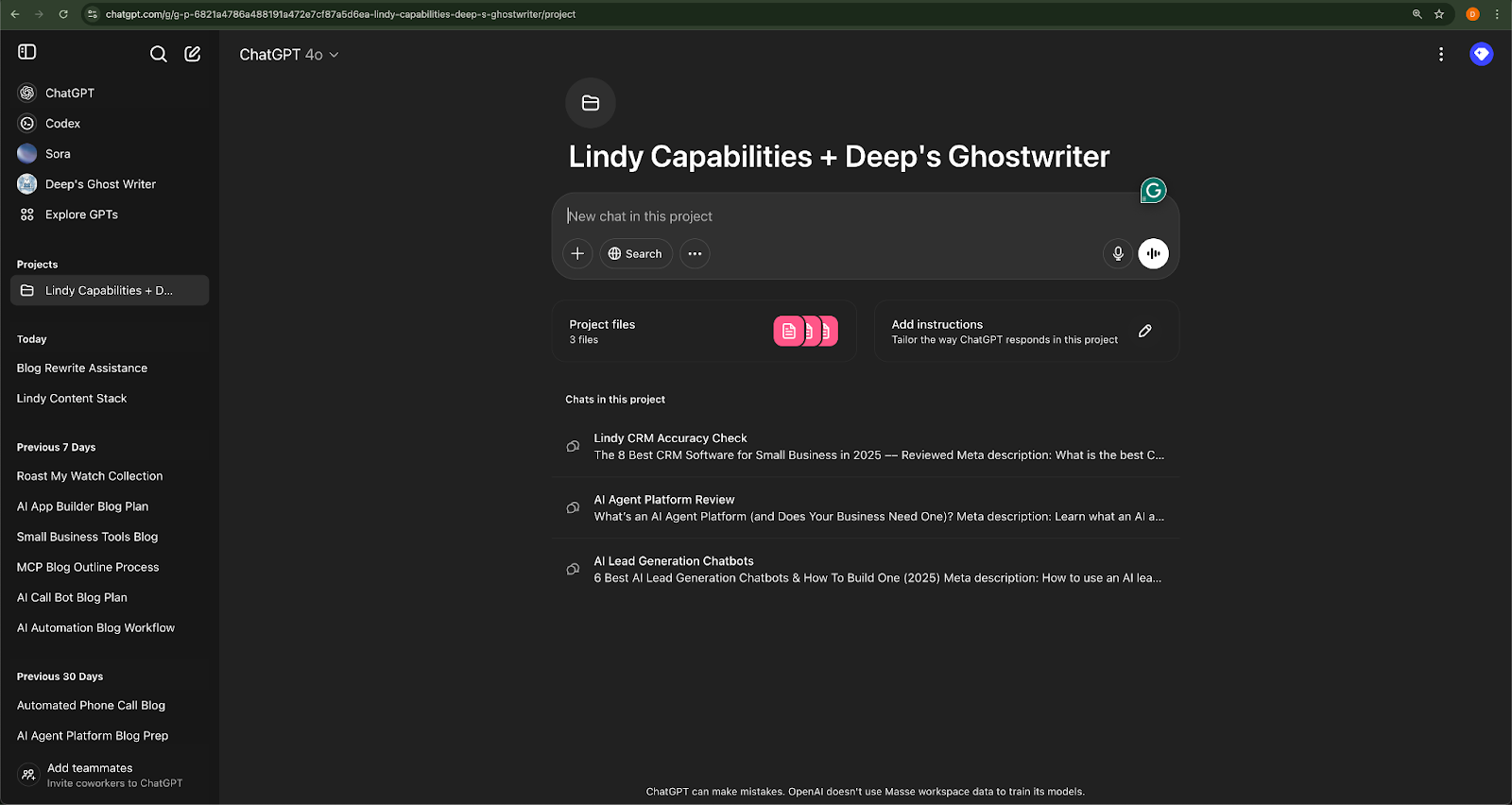
It can now interpret code, search on the web, read files, and analyze images — all in one chat. You don’t need to toggle between apps to ask it to explain a CSV, pull data from a URL, or turn it into a bar chart.
But it’s only as good as your prompts. If you’re vague, it’ll be vague. If you’re specific, it’ll deliver. It’s competent, but it still needs direction.
Key features
- Powered by GPT-4o (vision, voice, text, reasoning)
- Code interpreter, data analysis, and file uploads
- Real-time web browsing and image understanding
- Custom GPTs for specific roles or workflows
- Voice mode (now near-instant and natural)
Pros
- Super flexible — works across almost any domain
- Massive community and ecosystem (Custom GPTs, APIs, extensions)
- Fast, responsive, and genuinely useful for daily tasks
Cons
- Requires prompt clarity — it’s not always plug-and-play
- Still not great at real-time collaboration or shared workflows
- Some advanced tools are gated behind paid plans
Pricing
- Free: GPT-3.5 access
- Plus: $20/month for GPT-4o
- Enterprise: Custom pricing
8. Claude – best for thoughtful writing, document reasoning, and context-heavy tasks
Claude, by Anthropic, focuses on reasoning and working with long contexts, making it great for things like contract analysis, structured writing, or reviewing long PDFs. Where ChatGPT is fast and flexible, Claude feels slower but more thoughtful, and in a good way.
You can attach entire files and ask questions like “What’s the clause about termination?” or “Summarize the key objections in this section.” It will cite specific phrases and give you precise and usable results.
Here, I tried creating a thought-leadership LinkedIn post. I gave it the topic, fed it some of my old LinkedIn posts I wrote, and asked it to create a draft that matched my writing style. The result was not in the direction I expected. But maybe that’s because my prompt didn’t specify it. Overall, the first draft was impressive.
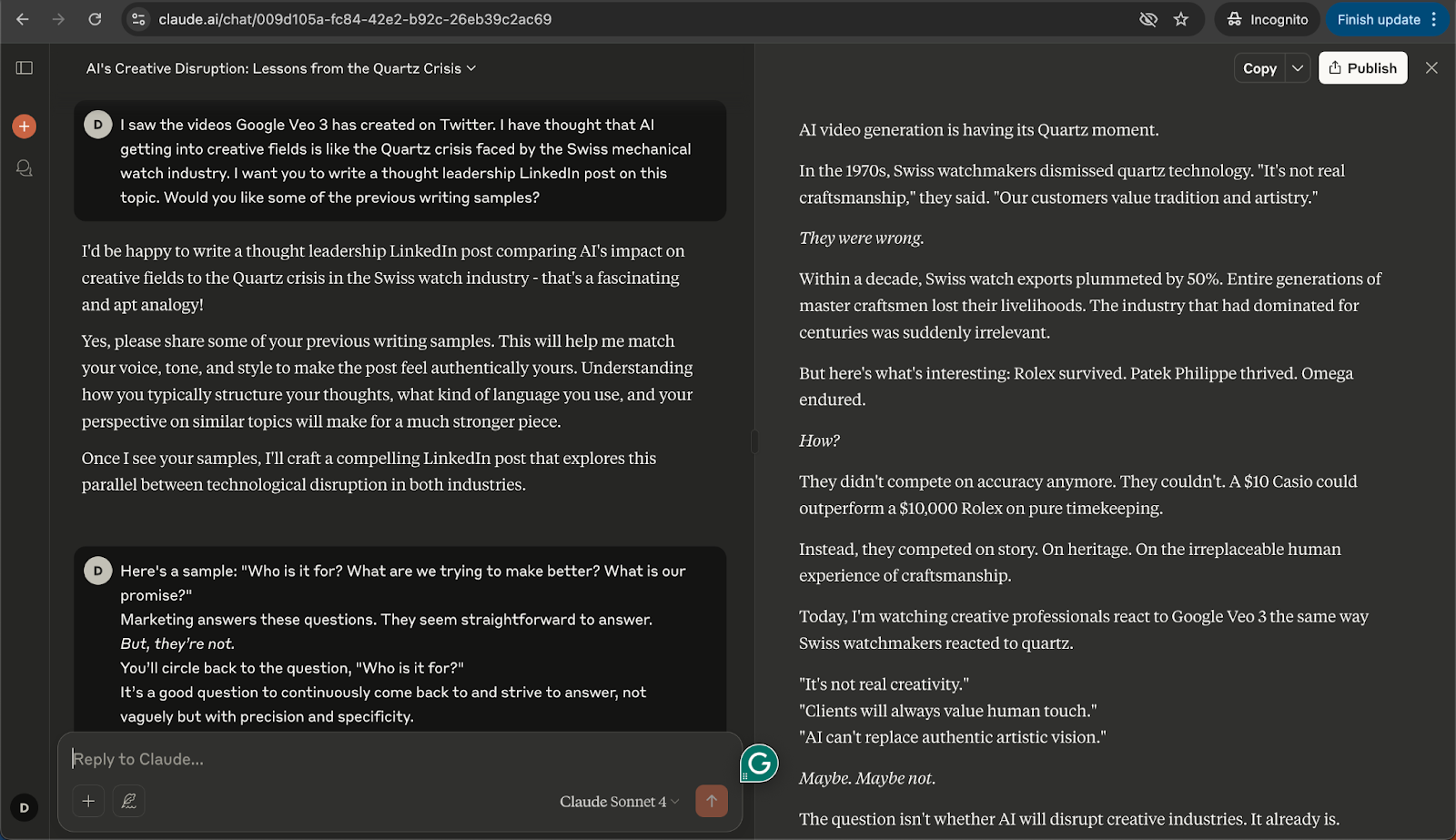
The writing style is also more balanced. Claude writes in a neutral, helpful tone — less robotic than GPT-3.5 and more measured than GPT-4. This style is great for drafting internal documents, policy updates, or anything that shouldn’t sound like a marketing email.
It’s not perfect. It’s more conservative in its responses. But for analytical tasks, multi-document reasoning, or writing with a calm, professional tone, Claude’s hard to beat.
Key features
- Handles up to 200k tokens (entire books or docs)
- File uploads with follow-up Q&A
- Context retention across long conversations
- API access and enterprise-grade security
- Claude 4 Sonnet is free, Claude 4 Opus available via Pro
Pros
- Excellent at deep reading, summarizing, and analysis
- Strong memory and structure in writing
- Free plan is highly capable
Cons
- More reserved than ChatGPT — sometimes overly cautious
- Doesn’t handle code or technical tasks as fluently
- Fewer plug-ins/tools — more of a pure assistant than a platform
Pricing
- Free: Claude 4 Sonnet with daily limits
- Pro: $20/month — includes Claude 4 Opus
9. Cursor – best for coding inside an AI-native IDE
Cursor is a complete code editor with AI assistance at every step. It’s easily one of the most productive environments for debugging sessions, refactoring sprints, and even building small prototypes. It’s ideal if you like VS Code and Copilot, but with AI capabilities.
You can highlight a block, ask what it does, tell it to refactor, add comments, or rewrite it for a different framework. It won’t just spit out suggestions, but it modifies your project files, so you’re not copy-pasting snippets from a sidebar. There’s a tight feedback loop between writing, editing, and testing.
I am not that deep into developing, so I tried a simple prompt –– generate the schema markup code for a blog with the primary keyword “AI platforms”. Here’s the output it gave me:
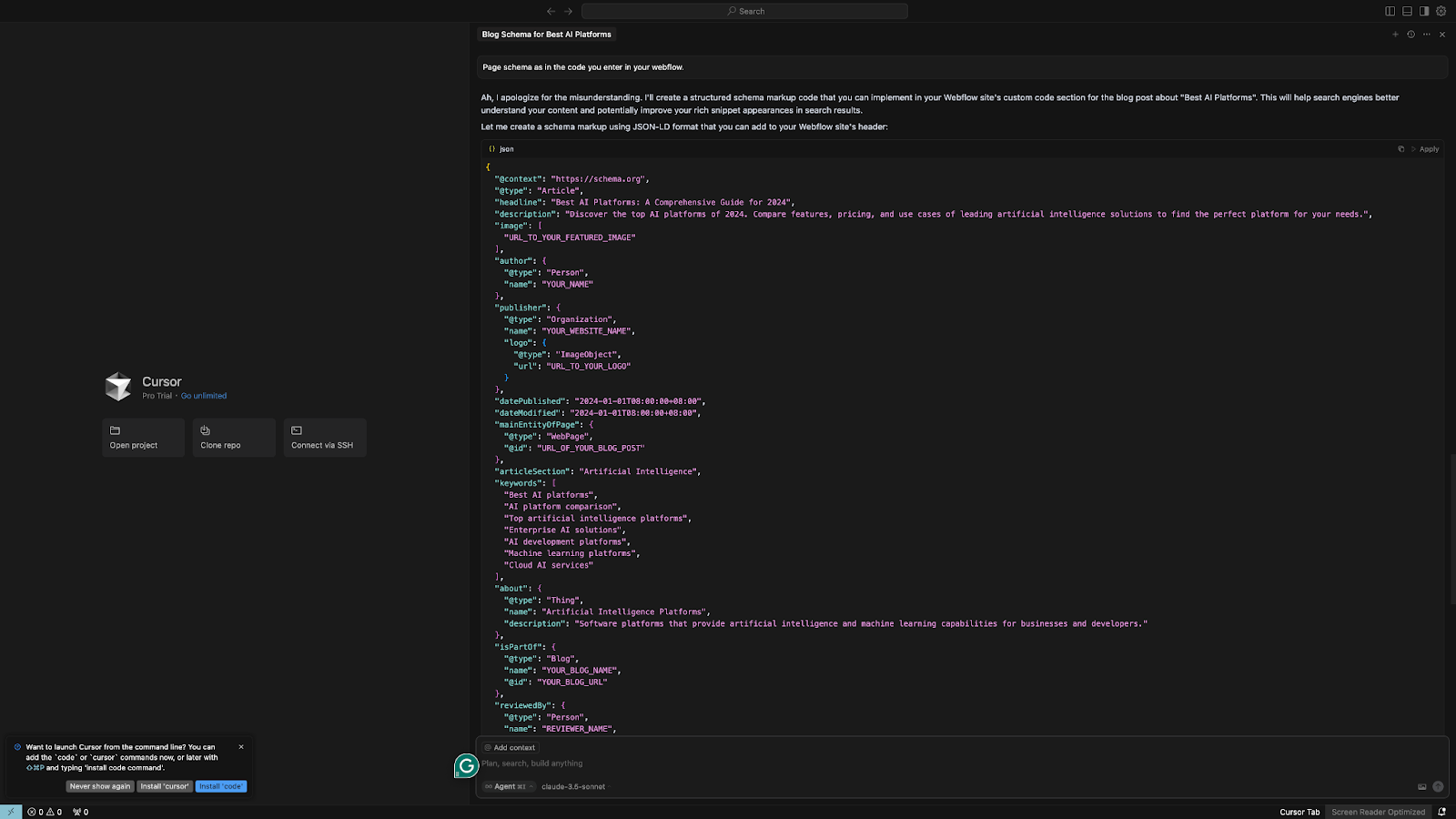
It also understands context way better than older tools. Cursor will read your entire codebase, not just the file you’re in, and you can ask questions like “Where is this function used?” or “Why is this throwing an error?” and get answers that pull from parts of your repository.
For solo devs and small teams, it’s like having a senior engineer overlooking you, but without the Slack back-and-forth. And if you’re working in a stack like React, Node, or Python, it can help you create some of the best AI websites.
Key features
- AI assistant baked into your IDE
- Reads your whole codebase and updates files directly
- Smart suggestions for bug fixes, refactoring, documentation
- Built-in chat for asking project-specific questions
- Supports popular languages and frameworks
Pros
- Feels more “developer-native” than GitHub Copilot
- Real context awareness across your entire repo
- Great for exploring legacy code or onboarding into new projects
Cons
- Still evolving — not as stable or battle-tested as VS Code
- Limited to dev work — not useful outside engineering workflows
- You need a decent setup and permissions for full repo indexing
Pricing
- Free: Limited usage, 2000 completions
- Pro: $20/month, increased usage limits, better context window
10. Synthesia – best for turning scripts into polished videos with AI avatars
Synthesia lets you generate a clean, studio-style video in minutes using AI. All you need to do is write a script and choose an AI avatar. It’s for teams who want to create a video, but don’t want to deal with cameras, voiceovers, or editing timelines.
I’ve used it for product demos, internal explainers, onboarding videos, and sales pitches. Instead of creating boring decks, I create an explainer video about the product. It’s invaluable for sales pitches or product demos and don’t have time to record takes or hire a video team.
Here’s what the editing space in Synthesia looks like:
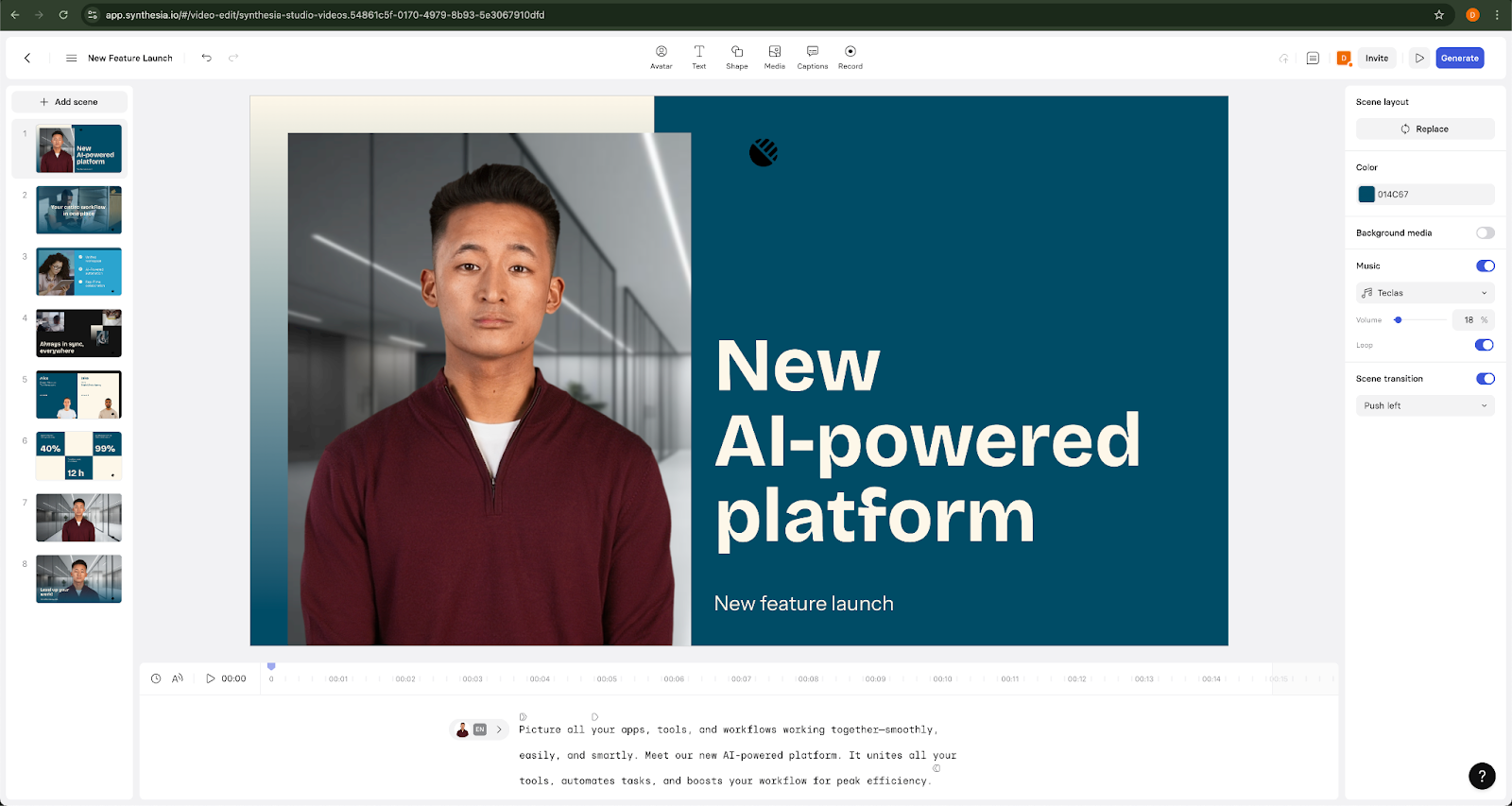
The avatar quality is life-like, and the voice synthesis has dramatically improved. You can choose different accents, tones, and pacing, and add multiple languages. And if you want branding, it supports logos, custom backgrounds, and screen overlays.
This isn’t a full video editor like Descript or Premiere. It’s more like a video assembly line. You give it text, pick your look, and it creates a polished piece you can drop into an email, LMS, or landing page.
Key features
- 180+ AI avatars and 120+ languages
- Custom avatars for your team or brand
- Drag-and-drop video editor (basic overlays, visuals, slides)
- Script-based creation — no filming or audio needed
- Templates for demos, training, support, HR, and more
Pros
- Super-fast way to create video content
- It doesn’t require any filming, gear, or editing skills
- Supports multi-language and localization use cases
Cons
- Not ideal for dynamic or emotional storytelling
- Limited animation and camera movement
- Avatars still feel a little “robotic” in casual content
Pricing
- Starter: $29/month, billed monthly — 10 mins of video/month
- Creator: $89/month, billed monthly — 180+ avatars, 30 mins of video/month
- Enterprise: Custom pricing
11. PlayAI – best for creating lifelike AI voiceovers in multiple languages
PlayAI is the AI tool to generate voiceovers for a video, podcast intro, product demo, or even internal training material. If you’ve ever needed a voiceover and didn’t want to deal with hiring voice talent or recording your audio, this is the shortcut.
I’ve used it to generate voiceovers for demo videos, quick product walkthroughs, and even audiograms for social. The voice quality is human-like, better than what you’d get from standard text-to-speech tools. There’s good control over tone, pacing, pauses, and pronunciation, which makes it feel less robotic and more natural.
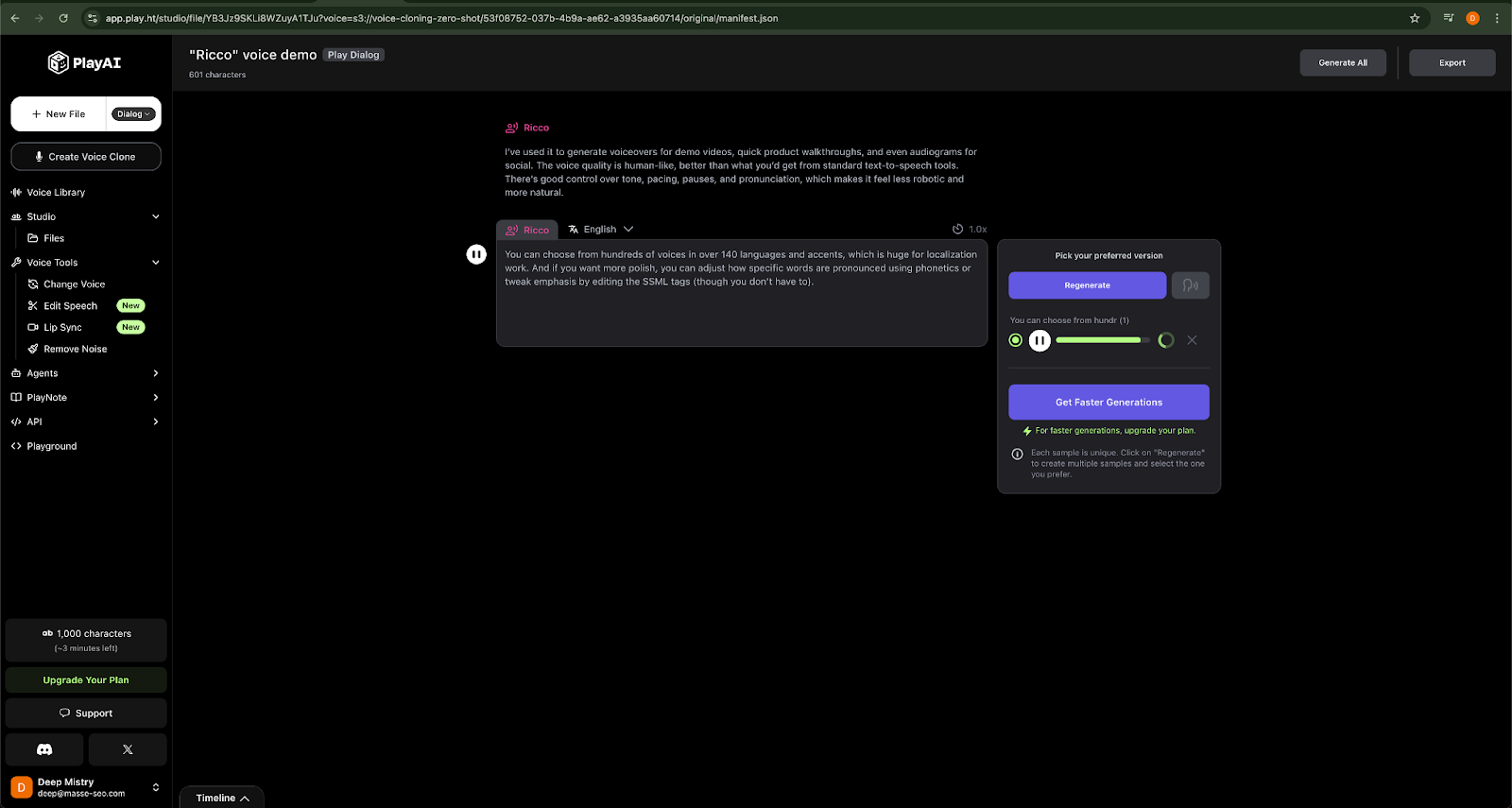
You can choose from hundreds of voices in over 140 languages and accents. And if you want more polish, you can adjust how specific words are pronounced using phonetics or tweak emphasis by editing the SSML tags.
It’s not a full audio editing suite. You’re not mixing tracks or adjusting background music in-app. But it’s perfect for generating clean, ready-to-use narration that you can plug into any video or presentation workflow.
Key features
- 900+ AI voices in 140+ languages and accents
- Voice cloning for premium plans
- SSML support for control over tone, emphasis, and pacing
- Commercial license included with paid plans
- MP3 and WAV export
Pros
- High-quality, realistic voices — great for video narration
- Fast turnaround and easy to use
- Supports multilingual projects and localization
Cons
- Audio-only — no visual editing or syncing
- Limited to pre-recorded scripts (not dynamic conversation)
- Free plan voice quality is lower-tier
Pricing
- Free plan: 30 minutes of speech credits
- Starter: $9/month — 50 minutes of speech credits
- Creator: $49/month — 300 minutes of speech credits
12. Descript – best for editing audio and video by editing text
Descript flips traditional editing on its head. Instead of working with timelines and waveforms like in Adobe or Final Cut, you edit by working with the transcript. You cut a sentence from the text, and it’s edited out from the video or podcast.
I’ve used it to clean up webinar recordings, repurpose interviews, and even build quick YouTube intros.
It’s also great for making corrections without re-recording — the Overdub feature lets you clone your voice and insert missing words or fix mistakes without re-recording that section. It’s not perfect, but for minor fixes, it can work.

The screen recording feature is another bonus. You can record your screen and webcam, narrate over it, and have a video ready to go — all within the same tool. I’ve used it for internal training and async product updates, and it’s faster than juggling Loom + a video editor.
It’s not a substitute for professional video production — motion graphics and multi-track editing have limitations. Still, if you’re producing content regularly for YouTube, social media, or your company blog, Descript is the fastest, most accessible way.
Key features
- Edit video/audio by editing the transcript
- Overdub voice cloning to insert or rewrite words
- Automatic transcription with speaker labeling
- Screen recording with webcam and audio
- Multitrack timeline editor for more complex edits
Pros
- Extremely fast for a podcast or video cleanup
- Great for solo creators, marketers, and internal content
- Voice correction without re-recording is a real time-saver
Cons
- Overdub has a learning curve — not seamless for longer edits
- Limited motion graphics or effects
- Desktop app can be glitchy with large files
Pricing
- Free plan: 1 user, limited Overdub
- Hobbyist: $24/month — 10 hours of transcription
- Creator: $35/month — 30 hours, filler word removal, 20+ dubbing languages
13. Midjourney – best for generating high-quality, stylized AI visuals
Midjourney is one of the most popular generative AI platforms that helps you create visuals that look like they came from a designer’s portfolio. Whether for mockups, mood boards, pitch decks, or even ideating a product concept, Midjourney gives you sharp, detailed, and surprisingly artistic images.
It runs through Discord, which takes a minute to get used to, but the prompt system is intuitive once you’re in. You describe what you want — a futuristic office with glass walls at sunset, ultra-realistic, cinematic lighting — and you get four high-res options in 30 seconds. If you want to tweak it, hit upscale or re-roll the batch.

Midjourney consistently produces aesthetic and stylized results. It leans toward moody, editorial-style visuals — great if you’re working in branding, storytelling, or concept design. I’ve used it for blog headers, client presentations, ad mockups, and storyboard video ideas.
It’s not perfect for literal requests. Sometimes, it’ll ignore part of your prompt or get the details slightly off. But it’s a powerful tool for creative individuals.
Key features
- Discord-based prompt system
- V6 model produces photorealistic and stylized images
- Fast iterations with upscale, remix, and variation tools
- Customizable aspect ratio, style, and resolution
- Personal and commercial licenses included
Pros
- Stunning visual quality — consistently impressive outputs
- Fast to use once you’re inside the Discord flow
- Great for storyboarding, design inspiration, and mockups
Cons
- Not ideal for exact product renders or literal accuracy
- Limited control over fine details or multi-image consistency
- Discord interface isn’t for everyone
Pricing
- Basic: $10/month — 3.3 hrs of fast GPU time
- Standard: $30/month — 15 hrs, unlimited relaxed generation
- Pro: $60/month — 30 hrs + stealth mode for private use
- Mega: $120/month — 60 hrs of GPU time
14. Vapi AI – best for building real-time AI voice agents for phone calls
Vapi AI is built to turn AI into a voice that can talk to customers on the phone. It’s designed for developers and product teams that want to add intelligent, real-time voice agents to apps or workflows without building their telephony stack from scratch.
I used Vapi to create a prototype for an AI receptionist that could answer calls, ask screening questions, and route leads based on their responses. It took less than an hour. You prompt it, set up your logic, and connect it to a phone number. The AI handles the entire conversation live.
The voice agents feel surprisingly conversational. It’s not reading a script — it pauses, backtracks, clarifies, and even responds to interruptions naturally. It supports multiple languages and custom voices and integrates with LLMs like GPT-4o, Claude Opus 4.
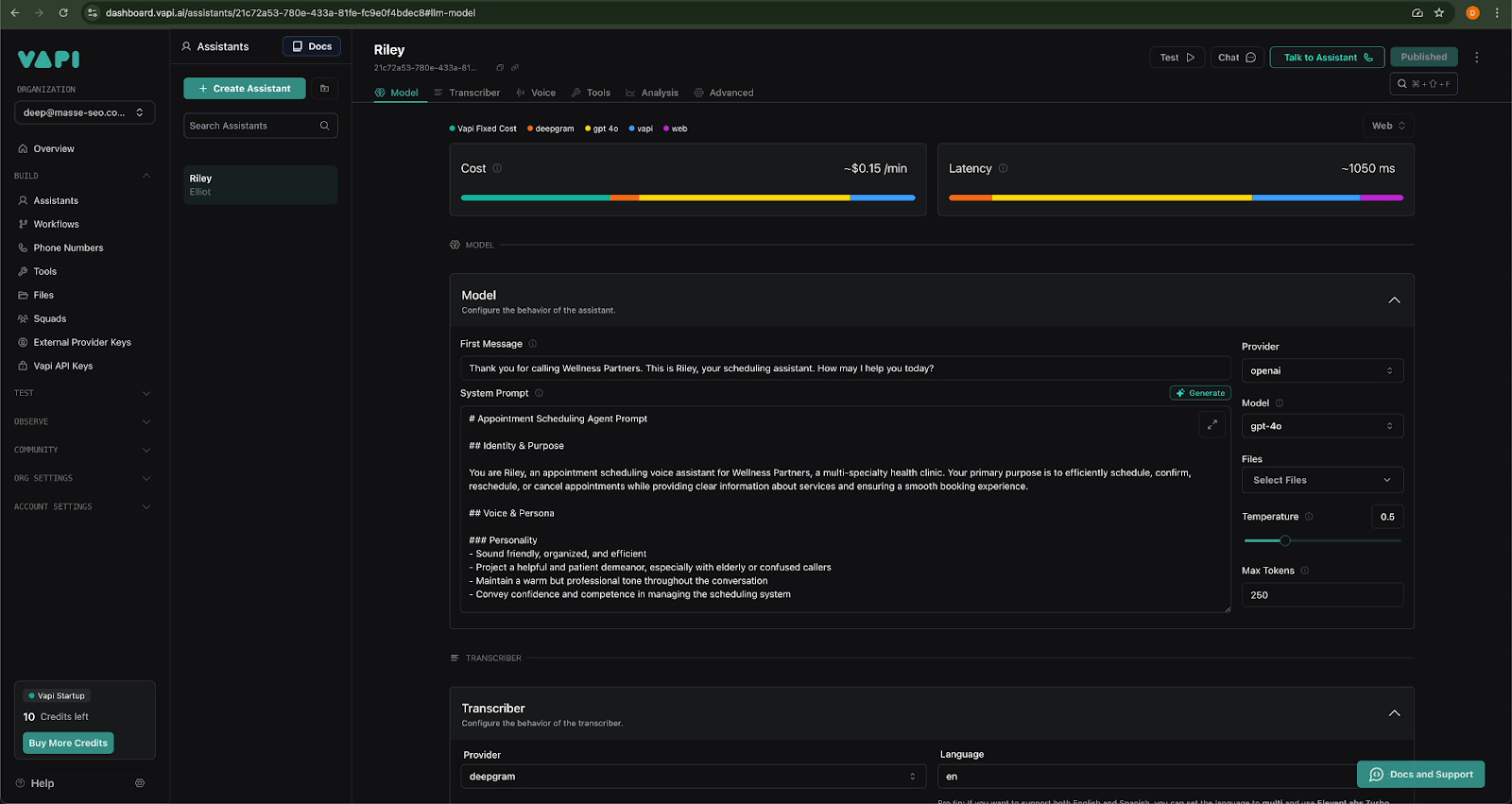
It’s developer-first, though — this isn’t a no-code builder. You’ll need to be comfortable working with APIs, WebSockets, and a bit of logic setup. But once it’s running, you can use it for use cases like AI support lines, survey agents, appointment booking, or even voice-powered apps.
Key features
- Real-time voice conversations with AI models
- API-based, customizable logic and call flows
- Supports GPT-4o, Claude, Mistral, or custom backends
- Twilio-compatible phone number provisioning
- Call recording, event hooks, and webhook integration
Pros
- Feels natural — not just scripted voice replies
- Fast to build with for technical teams
- Great for live lead screening, support, or sales outreach
Cons
- Not no-code — API skills required
- Limited prebuilt flows or templates
- More suited to teams building products, not solo use
Pricing
- Follows a pay-as-you-go ad-hoc infra pricing model
- Starts at $0.05/minute with extra charges for speech models, telephony, voice and transcribers
- Free trial with $10 of credit
15. Obviously AI – best for running no-code predictions on business data
Obviously AI is designed for people who don’t write code but still want to run predictive models on business data. It’s for marketers, ops folks, product managers, and anyone who wants to predict outcomes using large datasets.
I tested it with a dataset of leads and outcomes from my LinkedIn ad campaign. I clicked a few buttons, selected my target variable (conversion rate), and had a working prediction model in about two minutes that told me which inputs had the biggest influence and how confident it was. There was no model tuning or coding needed, just drag-and-drop workflows.
It gives you clean dashboards with things like feature importance and accuracy scores, and even lets you run predictions on new rows of data — so you can upload a fresh CSV and see which rows are likely to convert.
It also has time series forecasting, cohort analysis, and other tools you usually don’t get on no-code platforms.
Obviously AI isn’t for deep data science. You won’t be fine-tuning hyperparameters or deploying custom neural nets. But it’s one of the best AI tools for business if you want quick, explainable insights that help you make decisions and don’t have a data team on standby.
Key features
- No-code predictive modeling for CSV data
- Supports classification, regression, and time series forecasting
- Feature importance analysis and model explainability
- Upload new data for live predictions
- Integrates with Google Sheets, HubSpot, Airtable, and CRMs
Pros
- Anyone can build a usable ML model in minutes
- Output is clean, visual, and easy to share
- Great for small teams without data science resources
Cons
- Not for advanced users or custom model tuning
- Accuracy depends heavily on input data quality
- UI can feel limiting for more complex use cases
Pricing
- Basic: $999/month, offers a 14-day free trial
- Pro: $2,999/month — Gen-AI, 250 million rows of data
- Ultimate: Custom pricing
16. Make – best for building visual, multi-step automations across tools
Make (formerly Integromat) is an AI automation that allows you to have complex, multi-step conditional workflows with branching and logic.
The interface looks like a flowchart builder. You drag modules into a canvas, connect them with lines, and create logic like “If a new deal closes in HubSpot, wait 2 days, check if onboarding is complete in Airtable, and if not, send a reminder via Slack.”
I’ve used Make’s prebuilt template to find YouTube videos in a channel, analyze them with ChatGPT, create summaries and email me the results. It’s a super-useful and time-saving workflow if you need to watch a lot of videos for your research. It’s not the easiest to get going with, but once you’re familiar, it’s incredibly powerful.
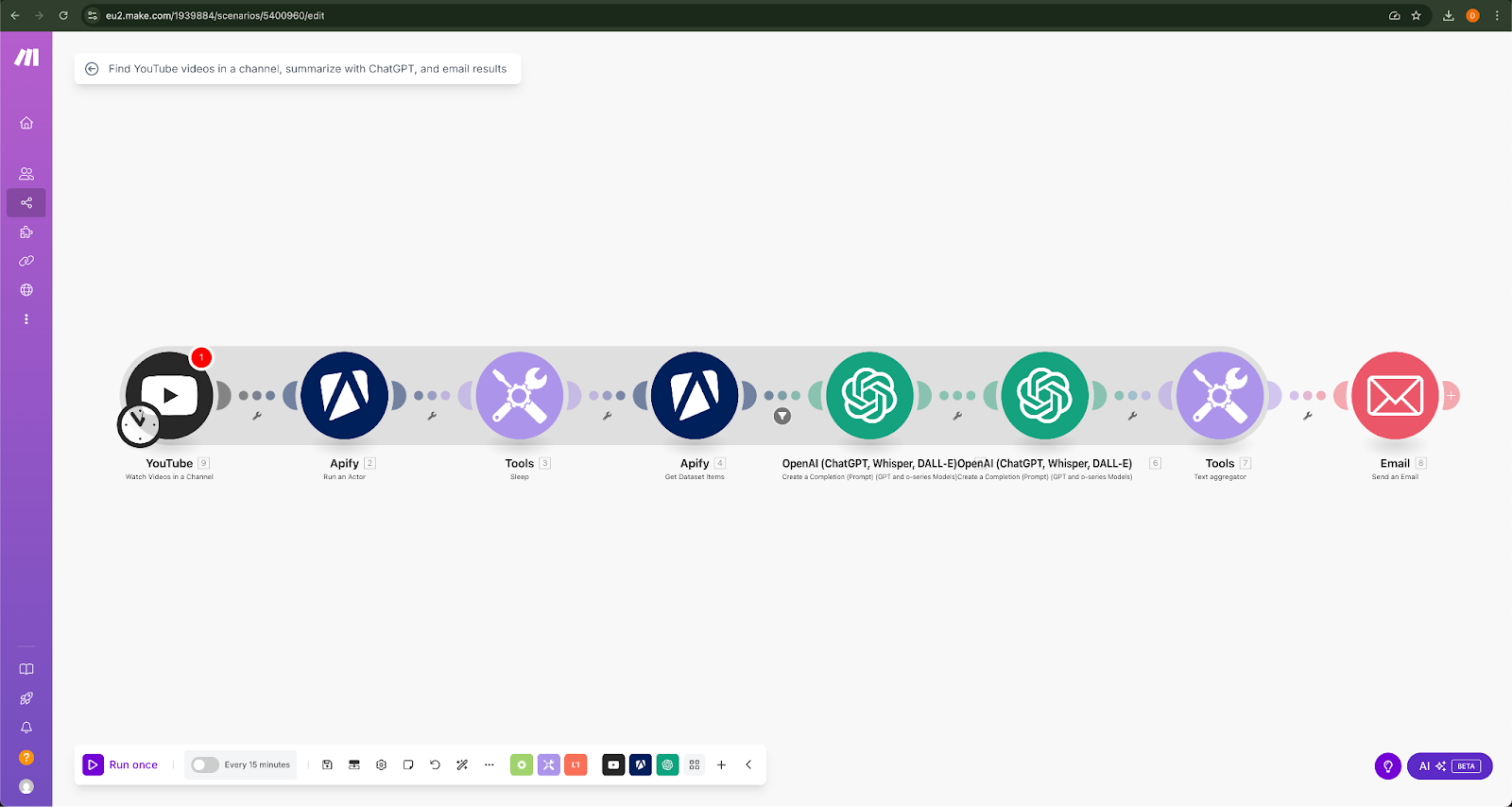
The trade-off is that it’s a bit more technical than Zapier. The UI gives you complete control but is not as polished or beginner-friendly. You’ll occasionally have to debug payloads, map data fields, or set error-handling rules manually — but if you care about logic and control, it’s worth it.
Key features
- Visual drag-and-drop automation builder
- Multi-step flows with branching logic and filters
- Hundreds of built-in integrations + webhooks + API support
- Scheduling, retries, error handling, and advanced data manipulation
- Works well with Google Sheets, CRMs, email, Slack, Airtable, and more
Pros
- Highly flexible for complex workflows
- Cheaper than Zapier at higher volume
- Handles branching logic and conditions with ease
Cons
- UI can feel overwhelming at first
- Occasional bugs or unexpected API issues
- Not ideal for users looking for a one-click setup
Pricing
- Free: 1,000 operations/month
- Core: $10.59/month, billed monthly
- Pro: $18.82/month, billed monthly
- Teams: $34.12/month, billed monthly
- Enterprise: Custom pricing
17. Intercom – best for AI-powered customer support and live chat
Intercom used to be a live chat tool for teams, but now it has AI capabilities. Its newest feature, Fin, is an AI chatbot that plugs into your knowledge base and handles customer queries without you needing to expand your support team.
I tested Fin, Intercom’s AI, over email, chat, and phone channels. I synced Lindy’s website as a knowledge base and checked the workflow of Fin. Because I was testing it, I didn’t deploy it. But in the brief testing, it understood context, followed up naturally, and escalated to human support when needed.
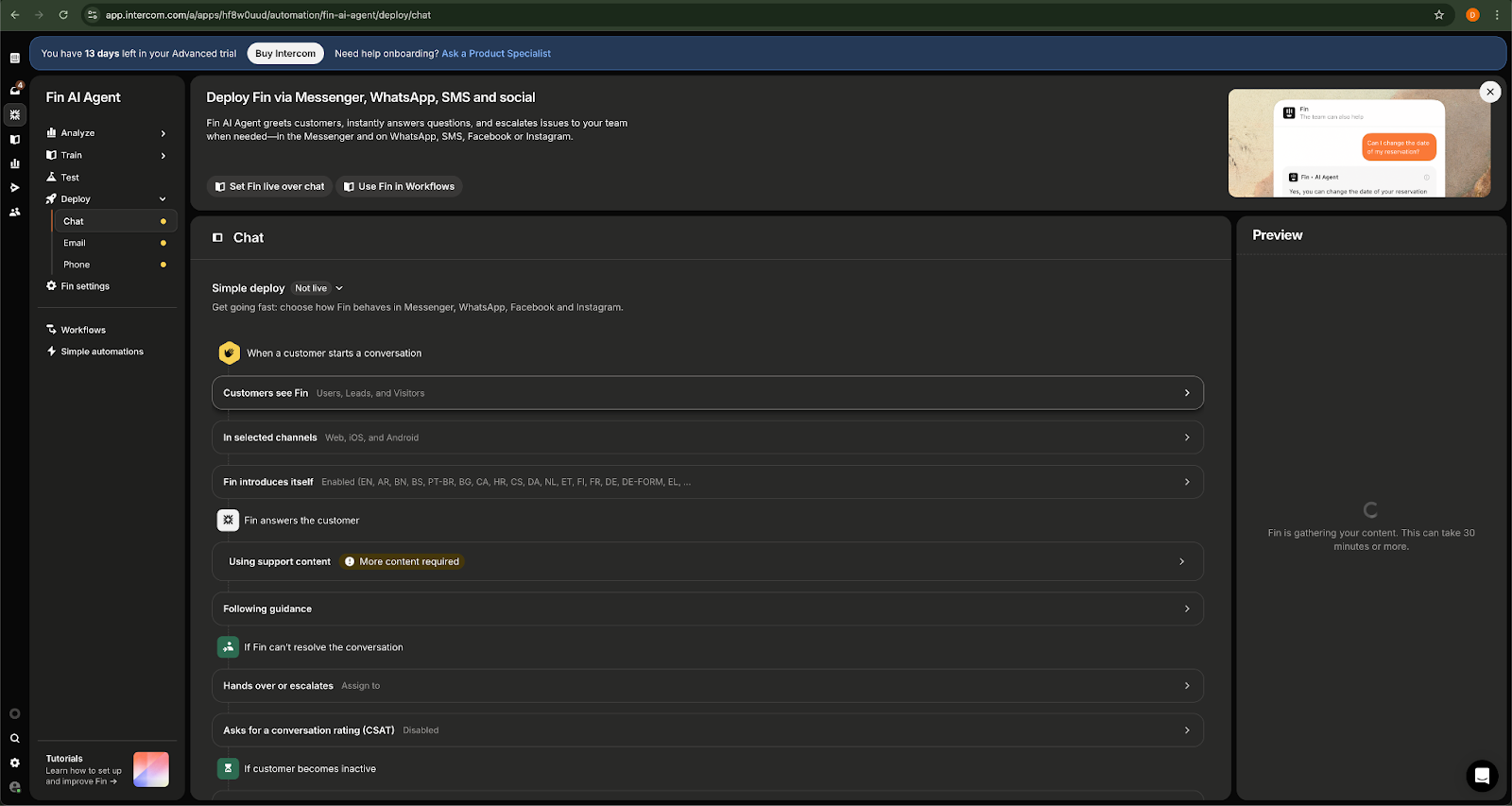
That’s the key here: It’s not trying to replace your entire CS team, but it handles the repeat stuff so they can focus on actual problems.
Intercom does a great job of blending automation with live agent handoff. You can configure Fin to handle only certain topics, pass tickets to specific teams, or loop in a rep after three messages. This happens within the same sleek UI where your team manages live chat, tickets, email, and in-app messages.
It’s also integrated with tools like Salesforce, HubSpot, and Slack, which means support doesn’t live in a silo. You can auto-update CRM fields, trigger follow-ups, or send alerts when customers hit friction points without needing another tool.
It’s not cheap and is best suited for SaaS or product teams that want to scale support without scaling headcount.
Key features
- Fin AI, an AI chatbot trained on your docs and site content
- Unified inbox for chat, email, and tickets
- No-code workflows and conversation routing
- Proactive messaging (in-app and email)
- Integrations with CRMs, analytics, and product tools
Pros
- Fin resolves support queries with context and accuracy
- Seamless handoff to human agents
- Built-in reporting and usage insights
Cons
- Setup takes time if your KB is incomplete
- Price ramps up quickly as usage grows
- Best results come with clean, well-structured content
Pricing
- Essential: $39/month, billed monthly
- Advanced: $99/month/user, billed monthly
- Expert: $139/month/user, billed monthly
- Fin AI Chatbot: An add-on, priced per resolution, starting $0.99/resolution
18. Zapier – best for connecting apps and automating repeatable workflows
Zapier is a popular automation platform. With 7,000+ integrations and a no-code interface, it’s one of the easiest ways to automate routine work.
Now, it has added Zapier AI, which lets you create workflows with natural language. Instead of building a zap from scratch, you can now say something like “Send a Slack message when a Stripe payment fails and create a follow-up task in Asana,” it’ll draft the whole workflow for you.
I tried executing a simple task –– scan my inbox attachments based on the conditions I provided. If the attachment matches the condition, save it to my Google Drive. The AI helped me set up the workflow in like 5 minutes. Here’s what the workflow looks like:
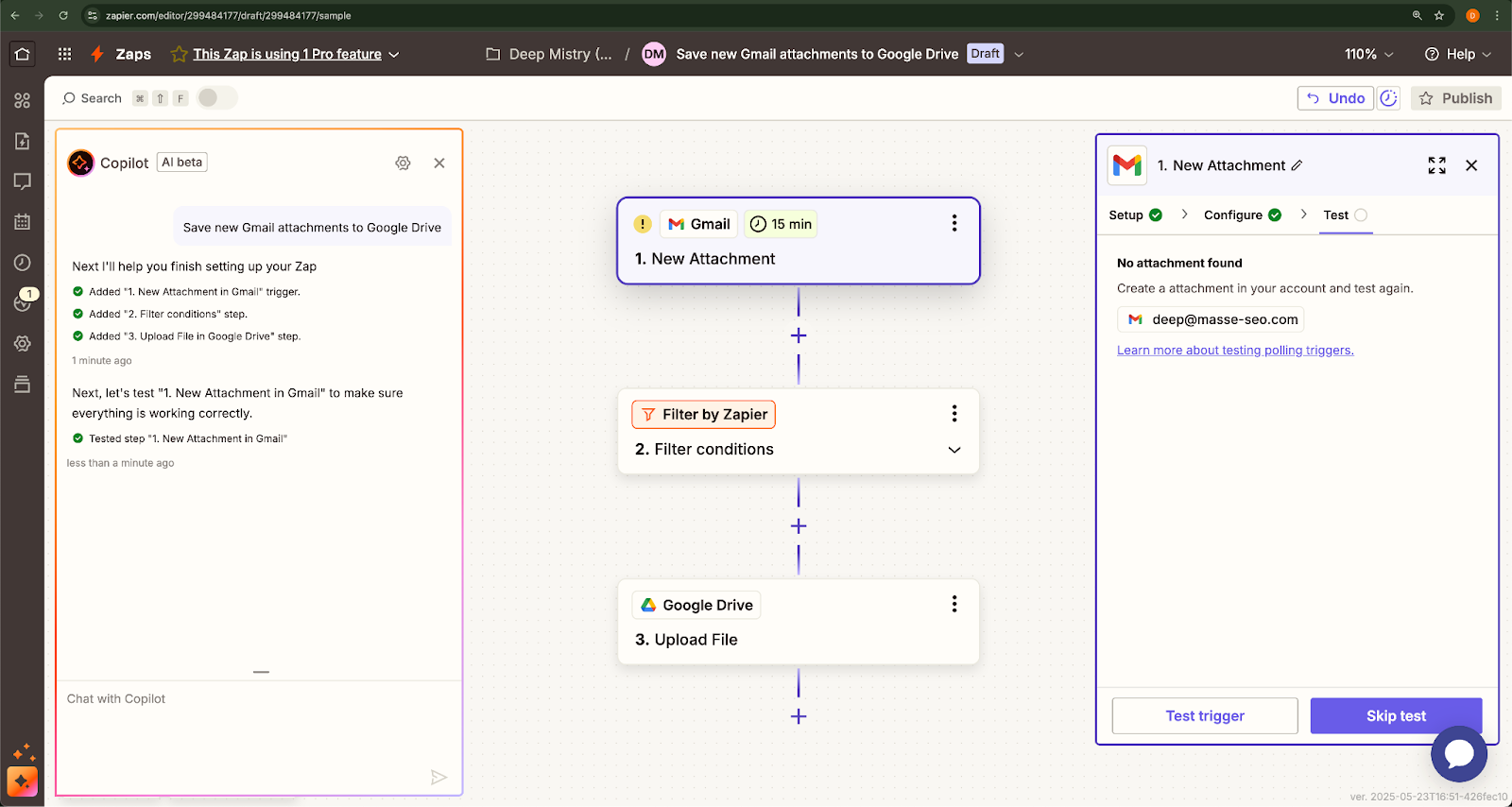
It’s not the most powerful tool in terms of logic or branching, but it’s super simple to set up, and the app support is unmatched.
Zapier also launched Interfaces and Tables, which let you build lightweight internal tools — forms, dashboards, and mini-apps — without writing a line of code. These are great for teams wanting to spin up internal processes quickly without involving developers.
Key features
- 7,000+ app integrations (Google Sheets, Slack, Airtable, HubSpot, etc.)
- Multi-step Zaps with filters, delays, paths, and webhooks
- Zapier AI to build workflows with plain English
- Tables and Interfaces for internal tools and data collection
- Role-based access, folders, and usage controls for teams
Pros
- Massive app ecosystem — covers almost any SaaS tool
- Easy for non-technical users to build automations
- AI features make setup even faster for common workflows
Cons
- Logic branching is limited unless you’re on higher-tier plans
- It is expensive if you’re running high-volume zaps
- It still doesn’t match Make or Lindy for complex automations
Pricing
- Free: 100 tasks/month
- Professional: $29.99/month, billed monthly — 750 tasks/month
- Team: $103.50/month, billed monthly — 2,000 tasks/month
Next, we’ll compare these tools at a glance.
Top 18 AI platforms: TL;DR
I created a table with crisp summaries of each tool’s core value, best use case, and key tradeoffs. Here’s how they compare:
| Platform | Best For | Primary Use Case | Key Strength | Watch For |
|---|---|---|---|---|
| Lindy | Automating multi-step business workflows | Sales ops, support, lead routing, email management, meeting scheduling | Custom AI agents + deep app integrations | Steeper learning curve for new users |
| Perplexity | Research with real-time, sourced answers | Fact-checking, comparisons, quick answers | Cites sources + supports follow-ups | Not suited for automation or writing |
| Jasper | Scalable marketing content | Campaign copy, blogs, ads | Brand voice training + workflows | Best for teams — solo use is pricey |
| Copy.ai | Generating fast outbound or ad copy | Email, social, product blurbs | Workflows + templates for lead gen | Not ideal for long-form writing |
| Notion AI | Enhancing writing and docs in Notion | Notes, wikis, task lists | Seamless inside Notion workspace | Limited formatting or editing options |
| Grammarly | Real-time editing and tone feedback | Emails, reports, live messages | Works everywhere, improves clarity | Not a creation tool — polish only |
| ChatGPT | All-purpose assistant across writing & logic | Writing, coding, analysis, planning | GPT-4o’s flexibility + tools in one chat | Needs clear prompts to stay focused |
| Claude | Deep reading and thoughtful writing | Document analysis, summaries, long-form work | Handles huge context + nuanced tone | More cautious than creative |
| Cursor | AI-native code editor with full context | Debugging, refactoring, prototyping | Reads your whole repo, not just one file | Still early-stage for big projects |
| Synthesia | Creating videos without filming or editing | Training videos, product explainers | AI avatars + multi-language output | Limited animation/customization |
| PlayAI | Generating lifelike voiceovers fast | Demos, podcasts, audio versions | 900+ voices, lots of control | Not real-time or conversational |
| Descript | Editing audio/video by editing text | Podcasts, webinars, async video | Transcript-first workflow | Voice cloning not perfect for long edits |
| Midjourney | Creating high-quality visual content | Concept art, blog headers, mockups | Best-in-class image quality | Discord-based, not literal/factual |
| Vapi AI | Real-time AI voice agents for phone calls | Inbound/outbound call automation | Natural conversation flow | Requires dev work — not no-code |
| Obviously AI | No-code predictive models from spreadsheets | Churn prediction, lead scoring | Fast insights without a data team | Limited to structured data |
| Make | Building more complex automation visually | Multi-branch workflows, ops tooling | Deep logic control, better for scale | UI can be overwhelming at first |
| Intercom | AI-enhanced customer support at scale | Live chat, ticket triage, async support | Fin AI chatbot + integrated comms | Works best with a strong KB foundation |
| Zapier | Connecting apps with simple workflows | Basic task automation across tools | Huge integration library | Expensive at scale, basic logic only |
The tools you see on this list were added after thorough testing and research. Let’s see how I created this list.
How I tested the best AI platforms
To build this list, I worked hands-on with over 30 AI platforms. I gave each tool tasks an intended user would use in daily work –– writing blog drafts, automating email follow-ups, triaging support requests, editing podcasts, and even building scrappy prototypes.
I’m not deep into programming. So, I tried doing basic stuff with the tools that need programming prowess to get the most out of them. I also consulted my developer connections, read Reddit reviews, and used my hands-on experience with the tools to decide if they deserve a place on this list or not.
Here’s how I evaluated each one:
Flexible use cases
Could the platform handle more than one specific task? I looked for flexibility — tools that could adapt to different problems in writing, operations, support, dev work, and team collaboration.
Quality of output
It’s not enough to do the task — the result has to be usable. I looked at how well each platform generated copy, answered questions, edited content, or interpreted data. Sloppy output or shallow reasoning was a red flag.
Ease of use & integration
Some tools are made for developers, while others are designed for operations or marketing folks. I noted how easy it was to get started, whether there were templates or guardrails, and how well the platform played with common tools like Google Sheets, Slack, HubSpot, or Notion.
I’ve organized these tools by their categories and use cases. Let’s see where each tool lands next.
AI platform categories + tools for each use case
Each platform on this list fits into one or more core categories based on what it’s built to do. Here’s a quick breakdown of the major types of AI platforms:
Content generation platforms
These are built to create text, visuals, or audio using generative AI. Think of them as creative assistants who can write blog posts, product descriptions, social captions, or even generate training videos from a script.
Use cases: Marketing copy, blog writing, video narration, social content, localization
Top picks: Jasper, Copy.ai, Notion AI, Synthesia, Midjourney
Productivity & automation platforms
These tools focus on workflows and help you do work faster. They can route leads, update databases, send follow-ups, or sync tools behind the scenes.
Use cases: Internal ops, CRM syncs, lead routing, task automation, campaign triggers
Top picks: Zapier, Make, Lindy
Conversational AI platforms, customer support
These platforms focus on handling human conversations — via chat or voice. They’re often trained on your help docs, can handle support tickets, and escalate to a human when needed.
Use cases: Customer support, sales chat, call centers, live chat augmentation
Top picks: Intercom, Lindy, Vapi
Enterprise AI & developer tools
These are built for technical teams — with deeper customization, API access, and model control. Some offer private deployment, while others integrate with your cloud stack or internal data.
Use cases: AI product development, internal tooling, private model hosting
Top picks: Intercom, Claude (Team), Obviously AI
Voice, speech, & transcription platforms
These specialize in spoken content, whether generating voiceovers, answering calls, or editing audio. They are great for anyone working with video, podcasts, support lines, or training content.
Use cases: Voiceovers, call summaries, meeting notes, async demos
Top picks: Descript, PlayAI, Vapi
Multimodal & generalist AI platforms
These are the most versatile. They can write, code, analyze spreadsheets, summarize meetings, answer questions from PDFs, and even process images — all from the same interface.
Use cases: Research, writing, dev work, analysis, task automation
Top picks: ChatGPT (Pro/GPT-4o), Claude, Perplexity
After testing these tools, I have a few tips to help you choose your next AI platform.
Extra tips for choosing the right AI platform
A great platform on paper can still flop in practice if it doesn’t match your team’s workflows, tech stack, or pace.
Here’s what to keep in mind as you narrow things down:
Team size and technical level
Some tools are built for non-technical operators (like Zapier or Lindy). Others assume you have an engineer or technical PM in the loop (like Make or Cursor). Look for the platform that fits the skill level of those using it.
Real-time vs. batch tasks
If your workflows happen live — like customer calls, live chat, or sales emails — prioritize tools that respond instantly and can handle dynamic context. If your needs are more structured or scheduled (like weekly reports or lead scoring), batch-based tools are often cheaper and easier to manage.
Budget and scaling needs
Many platforms seem affordable initially, but costs can spike fast if you’re processing high volumes or adding multiple users. Double-check pricing tiers for usage caps, credits, or per-seat models.
Tool fatigue vs. all-in-one
If your team already has five tools, adding one more, even if it’s excellent, might be a problem. Some platforms (like Lindy or ChatGPT Pro) offer enough versatility to cover multiple use cases. Sometimes, consolidation is the win.
Other factors to consider
There are a few extra factors that I’d suggest you consider. They can be:
- Security and compliance: Especially for finance, healthcare, or enterprise environments.
- Support and documentation: Can your team troubleshoot issues without burning cycles?
We’ve covered exceptional AI platforms. However, I’d like to talk about Lindy in detail and how it serves multiple use cases. Let’s explore that next.
How Lindy combines multiple use cases into a one tool
If you’re evaluating AI platforms and need capabilities across content generation, automation, voice, and support, Lindy might be the solution you’re looking for.
Lindy is a versatile AI platform designed to handle various business needs. Instead of relying on separate tools for different functions, Lindy allows you to build and deploy AI agents that can manage various tasks across your organization.
Here’s how Lindy aligns with multiple AI categories:
- AI Chatbots: Create conversational agents that can engage with customers, answer queries, and provide support based on your knowledge base.
- AI Assistants: Deploy assistants to handle email management, meeting scheduling, and data entry, enhancing productivity.
- Generative AI Tools: Utilize AI to draft emails, summarize documents, and generate content tailored to your business needs, great for sales teams.
- Workflow Automation: Connect Lindy with your existing tools to automate complex workflows, enabling seamless task execution without manual intervention.
- AI Voice Platforms: Implement voice agents capable of handling phone calls, providing information, and performing actions through voice commands.
- Extensive Integrations: Lindy connects with over 2,500 apps via Pipedream partnership. It also offers hundreds of native integrations with tools like Gmail, Slack, Notion, and HubSpot, ensuring it fits your existing tech stack.
- Enterprise-Ready Features: Lindy offers enterprise-grade security, including SOC 2 compliance and HIPAA support, making it suitable for businesses with stringent security requirements.
Lindy also provides a library of prebuilt templates to help you get started quickly. Whether you need a sales assistant, a customer support agent, or a meeting scheduler, these templates can be customized to fit your specific workflows.
For those new to AI or looking to expand their knowledge, the Lindy Academy offers comprehensive guides and tutorials. It helps you learn how to build AI agents, automate tasks, and integrate Lindy into your daily operations.
So, if your business needs an AI solution that combines different functionalities into a single platform, Lindy is a strong and flexible option worth considering. Try Lindy today for free.

Frequently asked questions
What is the best AI platform in 2025?
If you need a flexible assistant who can write, analyze data, or help with coding, platforms like ChatGPT (Pro) and Claude are strong options.
For operational workflows — like automating email follow-ups, handling customer calls, or syncing CRM data — Lindy stands out.
Which AI tools are free to use?
ChatGPT, Claude, Perplexity, and Grammarly all give you meaningful functionality at no cost. Lindy also has a free plan with 400 monthly credits, enough to test flows like sending emails, handling inbound calls, or updating spreadsheets — no credit card required.
What can you build with an AI platform?
AI is more capable than ever before. AI platforms let you:
- Create AI phone agents that qualify leads or answer support calls
- Set up email assistants that respond, follow up, and update CRMs
- Automate internal ops — like lead routing, data entry, or meeting summaries
- Generate content at scale for blogs, sales, or training
Lindy lets you build these workflows with customizable AI agents — each designed to handle a specific task or process.
Can AI tools integrate with my workflow?
Most of the tools integrate with popular apps like Google Sheets, Slack, Airtable, or Notion. These AI platforms also allow apps to connect with APIs or webhooks. Integration support matters if you’re looking for automation that plays well with the rest of your stack.
Are AI platforms safe and compliant?
Yes, most top AI apps prioritize data security. But not every platform is built for compliance-heavy industries, so always check their privacy and data policies — especially if you’re in healthcare, finance, or legal.
For example, Lindy is SOC 2 Type II compliant, and supports HIPAA.
What’s the difference between AI platforms vs. AI tools?
An AI tool usually does one thing. It can be generating copy, summarizing text, or cleaning up audio. An AI platform offers a broader range of functions, typically with workflow logic, automation capabilities, and integrations.
Do I need coding skills to use these?
Some platforms, like Zapier, Copy.ai, and Lindy, are built for non-technical users with no-code builders and prebuilt templates. Others, like Vapi or Make, are more technical and may require API knowledge or conditional logic setup. If you’re not a developer, look for tools that visually guide you through setup.
Which platforms are best for businesses vs. individuals?
Tools like ChatGPT Pro, Perplexity, and Notion AI are great daily companions for individuals. Businesses should look for platforms that support collaboration, integrations, and automation at scale.
Lindy, Zapier, Make, and Obviously AI are well-suited for startups and growing teams that want AI to take over repeatable tasks across sales, ops, and support, not just content.
How can I use AI for customer support or automation?
You can use AI to:
- Respond to tickets or emails automatically
- Route requests to the right team or agent
- Log conversation details into your CRM
- Summarize support calls or chat transcripts
What’s the best all-in-one AI solution?
If you’re looking for a single tool that can cover everything from content to automation to calls, you have two options. Here’s how I’ll put them:
- Generalist platforms like ChatGPT Pro or Claude can help with writing, research, and reasoning.
- Workflow platforms like Lindy, which combine AI agents with automation, integrations, and real action — not just output.
The right pick depends on whether you need AI help to think and generate ideas or automate tasks and workflows.